Showing posts with label Bitterns. Show all posts

Saturday, 10 September 2016

The rejuvenation of Leighton Moss

Leighton Moss wetland rejuvenation from graham white on Vimeo.

Leighton Moss was traditionally the stronghold of the Bittern in north-west England and, along with Minsmere, was one of the sites that provided much research knowledge when the Bittern population was at a very low ebb in the 1990s.   However, whilst Bitterns are now surging upwards elsewhere on the back of this research, they continue to decline at Leighton Moss. Yet the site continues to support one of the best densities of Eels and other fish, the Bittern’s main prey, that we have come across.  So what is going on?  The issue is that Leighton Moss is an old and ‘littered’ reedbed. Recession of the reed margins away from silted pools and ditches is making the fish less available to a foraging bird. The problem of reed recession in old reedbeds is well known.  The formation of toxic by-products by the reed litter under anoxic conditions in a high, stable water regime, reduces reed shoot density and vigour.   Reed re-colonisation into anoxic sediments is known to be poor.  This issue is compounded at Leighton Moss by high grazing pressure from an increasing population of Red Deer and by Greylag Geese.

However, when reedbeds start to die-back due to the ageing processes described above, or grazing (by geese or deer for example), the extent of healthy reed can be increased by lowering water levels to expose mud and allow new plants to germinate and establish.  Periodic drying out can be used to vary the proportions of open water and swamp vegetation and effectively rejuvenate the habitat.  Such a pattern of management has been used in the Oostvaarderplassen in The Netherlands.  A mosaic of reed and open water habitat is maintained by a combination of fluctuating water levels and grazing by Greylag Geese. This results in a periodic expansion and recession of reed.  During high water levels, the geese graze back the margins of the reedbed.  During low water levels, the exposed mud is colonised by reed, other swamp plants and ruderals.  When water levels rise again, the seeds of the ruderals provide food for wildfowl and the new reed shoots form an expanding reedbed.

So in 2014, water levels were lowered on Leighton Moss to reveal acres of gloopy mud, with the aim of drying the site during the summer months for a number of years.  In addition, a small cull of Red Deer began, with the aim of reducing their grazing impact.  Such actions that result in changes to the accepted norm are not always popular, but an appropriate quote for this situation might be: ‘If you want things to stay the same, you have to change them’.


By August 2016, significant changes had taken place.  The gloopy muds had consolidated and vegetation was spreading across it.  Reed was both germinating in the damp mud and spreading out by extending runners from the established clumps.  Early colonizing plants such as Golden Dock and speedwells were abundant, providing a massive boost of seed for wintering wildfowl.  The lowered levels bring other changes: more waders in front of the hides and Spotted Crakes appearing in the reedbeds.  Another year or two of lowered water is probably required before returning to a more normal water regime.  We should then see a boost in many species.  However, whether Bitterns will return to their former glory is uncertain.  The reedbed will be healthier but it is still an old, rather dry reedbed, and as such will support a different, but just as important, range of wildlife.

Below:  the same view, 2014,2015 & 2016


Thursday, 6 June 2013

Landing pad for Little Bitterns


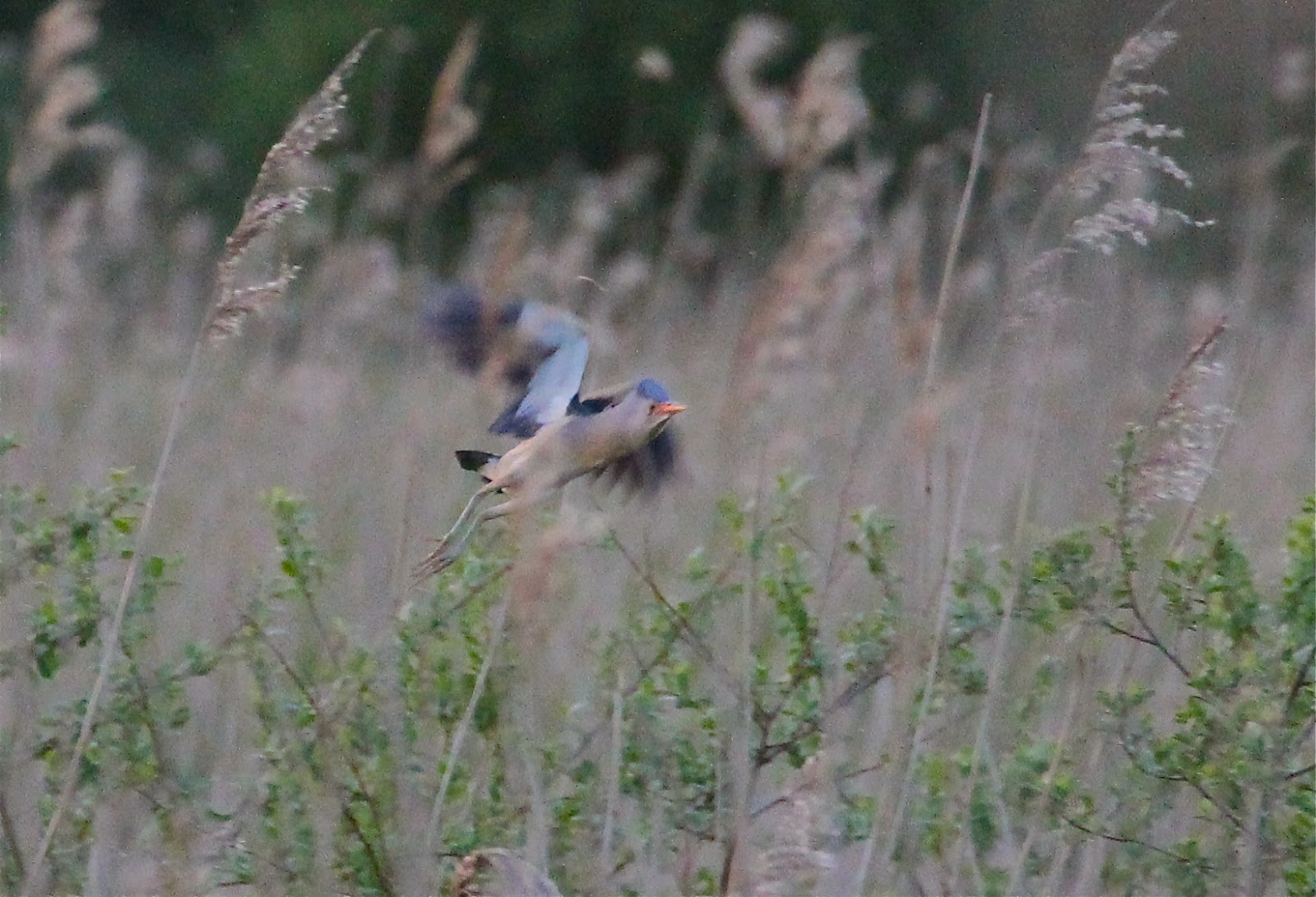
“Jig jig jag jag, ping ping, boom, woof....woof....woof”.  Singing Reed Warblers everywhere, Bearded Tits feeding young and I can hear six booming Bitterns around me.  A Great White Egret flies by and a hidden Garganey rattles from a nearby reedy pool.  As it gets dark a Spotted Crake whips from the ditch next to the path.  Where am I?  Another foreign jaunt?  No, in deepest England on a wetland that didn't exist 20 years ago.  Woof....woof....woof, Oh, did I mention the singing Little Bittern.

Where wetland colonists are concerned, a recent study has shown that the six species that have established populations in the UK since 1960 all started to breed in protected areas.  Furthermore we know that larger sites are more likely to attract colonising species.  Such areas have been described as ‘landing pads’ for colonising species, allowing them to become established before viable populations spread out.  Ham Wall (and the wider Avalon Marshes in which it sits) is living proof of this as we hopefully see the first stages of Little Bittern establishing a regular population in the UK. 
Climate change analysis predicts that Little Bittern may colonise southern England. Although populations on the continent declined sharply over recent decades, the cause of which is considered to be drought conditions in the wintering areas, some recovery has been evident in the last ten years.  The Ham Wall birds returned this year as usual in early May and feeding flights will hopefully be evident soon.  The Avalon Marshes ‘heron hot spot’ is rapidly taking over from Suffolk as the key area for (Great) Bitterns in the UK, with 35 boomers this year.  At Ham Wall there are 12 boomers with at least 5 nests pinpointed so far from feeding flights.  

Previously I had looked at the developing reedbed ‘rejuvenation’ area, which as predicted, attracted good numbers of waterfowl in its early flooded phase.  A singing Pied-billed Grebe, along with Ferruginous Duck and Ring-necked Duck, were the highlights.   There were still plenty of duck on show during my visit – Pochard, Tufted, Shoveler, Wigeon and a couple of Garganey - but high water has pushed any waders to the margins.  Just a dozen Black-tailed Godwits, a few Redshank and a Whimbrel were visible.  However, as water levels drop by late summer, the area should increasingly attract a good range of autumn passage waders and waterbirds.

below: rejuvenation area and reed-nesting Grey Herons


Sunday, 17 March 2013

Comings and goings


Despite the reluctance of winter to give way to spring, comings and goings have been evident in the last few days.  Today at Hall Marsh, where some excellent management has been undertaken by the Lee Valley Park, a Little Ringed Plover was back on territory, a Sand Martin headed north and a Chiffchaff sang from nearby bushes.


A few days earlier I had waited in vain at Amwell for a Great White Egret to return to the roost, but luckily witnessed a far more interesting event.  At dusk a Bittern drifted headed across the lake and dropped into its usual reedbed roost site. Nothing unusual there.   However, 15 minutes later, in the gathering gloom it rose out of the reedbed to begin circling up into the sky giving the little known ‘gull call’.  Within a minute or two a second bird had risen out of the reeds to join it, both dark shapes now just visible circling over the lake.  As they rose and drifted northwards, a third calling bird appeared from the south to circle the lake.  This bird disappeared high into the gloom back southwards with its far carrying call audible long after the gloom had swallowed up it’s shape. 
The ‘gull call’ can be given by both male and female Bitterns and has mainly been associated with pre-migration behaviour when birds circle up into the sky at dusk.  This behaviour is well known on the continent, where groups of up to 20 birds are noted at key wintering or passage sites.  However, the ‘gull call’ may also be heard in aerial chases over breeding sites in early spring. 


Although many of our wintering Bitterns are assumed to come from the continent, there is little firm evidence of this.  However, satellite tagging birds in the Netherlands has produced some interesting results.  Check out Anneke on this page.    Anneke was ringed in the Netherlands in 2011.  In October she arrived in the UK over Hull, toured Wales and then settled at Slapton Ley in Devon from late November to the end of February. On February 26, she flew back to the Netherlands with a stopover in East London after a flight of 900 m above the city.  Then she returned to her natal site, crossing the North Sea at over 60 miles per hour.


So our Lee Valley birds may be heading back to distant breeding areas but there is plenty of Bittern breeding activity in the UK already this spring, with a remarkable 35 booming birds in Somerset, good numbers in the north of England and some new sites occupied. With Great White Egrets also getting jiggy on at least two sites, this spring will be interesting.

Friday, 28 December 2012

Don't tell him Pike


I saw my first Bittern in Nightingale Wood in 1972.  The London Bird Report has it as:  Cheshunt GP, one on Mar 4th (GJW).  Hmm, rather brief for what I seem to remember was a good find at the time.   However, over the years this has become a regular haunt for wintering bitterns.  So why do Bitterns return to this spot year after year?

Nightingale Wood is a wonderfully scruffy few acres of wet self–set woodland on the edge of a badly restored gravel pit.  It’s landform is varied to say the least: hollows, holes, slopes, cliffs, pools and piles of reject gravels.  Initially colonised by Hawthorn and willow scrub but now succeeding to Ash and Alder, with masses of dead wood. The modern mineral planning officer would never allow it.  They would smooth everything out, cover in top soil and insist on regimented rows of planted trees, and in doing so would eliminate any decent habitat.

Nightingale Wood? I hear you say.  Well yes, once upon a time in the scrubby days, 2 or 3 pairs were to be found.  I found my first Nightingale nest in this wood and watched the youngsters fledge.  Many a Willow Tit nest was also noted.  Over the years the wood has provided regular Woodcock, Water Rails, Siskins and Redpolls , but also 3 Golden Orioles, 2 Firecrests, 2 Wood Warblers, Pied Flycatcher, Great Grey Shrike, Bearded Tits and a roost of 9,000 Fieldfares one night.  The edge of the wood grades into the water-filled pit through tumble-down wet woodland and marshy spits to a reedbed fringe of about an acre.

This is where the Bitterns come in. So why do Bitterns return to this spot? The varied topography of the wood continues out under the water with deeper pools interspersed with reedy shallows.  Research papers will tell you that Rudd and Eels are the preferred prey of breeding birds in the UK, but Perch and Pike aplenty tuck into these watery hollows in the reedbed during the winter and form the main prey for Lee Valley Bitterns in the lean months. Good feeding at this time of year is crucial for getting the birds through the winter and into good condition for breeding.

I returned to Nightingale Wood yesterday for an hour or so at dusk and a couple of Bitterns were on show.  There are currently 7 or 8 Bitterns wintering in the Lee Valley, with 5 in the Cheshunt pits complex.  The reedbed now has excellent viewing rides cut into it by the Lee Valley Park Authority.  One Bittern duly appeared on the edge of a reedy ride no more than a dozen paces from my original sighting in ‘72.   It caught a nice stripey Jack Pike and soon dispatched it.  At dusk both birds moved with just a brief few wing-beats from the feeding spots to the safe roosting areas on the edge of the reedbed.   That’s why they come back here.

Wednesday, 29 August 2012

House of reed


Blundering around inside a reedbed is all in a normal day’s work for a Grumpy Ecologist, usually ending up thoroughly wet and ‘bloodied’ with reed-cuts.  The subtle variations of reed height and density, and the water depth, provide a guide to the location of the reedy constructions of some of the reedbed inhabitants.


Water Voles can be extremely common in wet reedbeds, with latrines and feeding stations every couple of metres.  One of the less frequently mentioned signs of Water Voles is the ‘Vole Mansion’ (above photo) but deep inside reedbeds these constructions can be very numerous.  The neat ball of woven reed strips is slung within a reed framework and under a loose reedy roof, the supporting reeds trimmed off with a typical Water Vole bite.  They are often provided with a reed ramp access down to an outside latrine.  The whole mansion is around 25 cm high and 20 cm in width.


The Water Rail nest is a neat cup, about 15 cm across, of woven reed.  Built just above water level, this one was in 35 cm of water depth and typically built just above water level.  Most Water Rail nests seem to have a covering reed ‘canopy’; this one (below) is open, however it was located in tall (240 cm) and dense reed (360 stems/m2).
 
Most Bittern nests also seem to be built just above water level with good, stout, reed stems bent over and folded in, before a woven platform around 40 cm in diameter is constructed on top.  A lining of finer material, other aquatic plants if present nearby, may be added.  One or two reed ramps lead down to the water.  The deepest water I have found a Bittern nest in is 115 cm.  The nest shown below is perched at an unusually high 110 cm on its scaffolding, above 62 cm of water, but remained above this spring’s rising water levels.  A scattering of downy feathers in and around the nest provides some pointers to the successful outcome.  She obviously had heard the weather forecast. 


Thursday, 22 March 2012

Recession


Or does it?  Usually a sound equation for breeding Bitterns is good supply of fish, especially Eels, added to a wet reedbed.  As the Bittern booming season gets going, with the remarkable early news of up to 30 boomers in Somerset, a very few sites stand out as being stuck in the recession.  The most noteworthy is the former Bittern stronghold of Leighton Moss, where I recently returned to undertake two days of electro-fishing and take a long, hard look at the reedbed.  The major concern is the almost terminal decline in Bittern, against the national trend.

Leighton Moss supports one of the best densities of Eels and other fish that we have come across, yet the Bitterns are declining.  Recession is indeed the problem; recession of the reed margins that is, making the fish less available to a foraging bird. The problem of reed recession in old reedbeds is well known.  The formation of toxic by-products by the reed litter under anoxic conditions in high, stable water conditions reduces reed shoot density and vigour.   Reed re-colonisation into anoxic sediments is known to be poor. 

However, when reedbeds cease expanding (or start dying-back) due to the ageing processes described above, or grazing (by geese or deer for example), their extent can be increased by lowering water levels to expose mud and allow new plants to germinate and establish.  Periodic drying out can be used to increase or decrease the proportions of open water and swamp vegetation and effectively rejuvenate the habitat.

Such a pattern of management has been used in the Oostvaarderplassen in The Netherlands.  A mosaic of reed and open water habitat is maintained by a combination of fluctuating water levels and grazing by moulting Greylag Geese. This results in a periodic expansion and regression of reed.  During high water levels, the geese graze back the margins of the reedbed.  During low water levels, the exposed mud is colonised by reed, other swamp plants and ruderals.  When water levels rise again, the seeds of the ruderals provide food for wildfowl and the new reed shoots form an expanding reedbed.

However, such management may seem drastic, particularly when short-term views are taken.  But, in a recession, do you simply squeeze tighter and deliver the Bittern’s P45, or try to promote new growth?


Thursday, 10 November 2011

Old and new


It’s interesting to compare sites and over the last week I’ve looked at the development of some new sites and the problems on some old ones.  The new included the still rather raw Frampton Marsh in Lincolnshire, where the scrape habitats, once fully functioning, promise to be amongst the best in the country.  A murky day delivered a Black Brant amongst hundreds of Brents, a Great Grey Shrike, Hen Harrier, Blackbirds and Fieldfares dropping in from a grey sky, and a plate of Blewits for supper.  A day later, the early signs of a diverse habitat of reedbed and heathland were evident at Snape in Suffolk, with young, vigorous reed romping across the re-wetted valley.  The old sites included North Warren, where a Dusky Warbler tacked away in the bushes and the first White-fronted Geese of the autumn dropped in, and, a few days previously, Leighton Moss in Lancashire, where my undoubted highlight was a Great White Egret flying behind a Marsh Harrier circling over a feeding Otter, although roosting waders on the saltmarsh pools was not far behind.

The loss of breeding Bitterns from the reedbed at Leighton Moss has been a cause of some concern and debate.  The fundamental problem at Leighton (for Bitterns at least) is that it is an ageing reedbed.  Reed die-back around the meres has been noted for many years, with a recent replacement by Reedmace.  Reed die-back is a well known issue in older reedbeds, resulting in poor quality reed with a low genetic diversity. The formation of toxic by-products by the reed litter under anoxic conditions reduces shoot density and vigour.  Reed re-colonisation into anoxic sediments is also known to be poor. At Leighton, the grazing effects of both moulting Greylags and numerous Red Deer are likely to be a significant contributory factor.

We know that fish biomass is way above the accepted threshold levels for Bitterns and that eels are as abundant as at any site.  The site supports several wintering birds yet the one remaining boomer is of poor quality and a late starter.  This all strongly suggests that a lack of fish availability in the reed/water interface is preventing birds reaching breeding condition, with a lack of secure nesting sites due to the drier conditions an additional problem for Bitterns.

However, Leighton Moss remains a superb wetland habitat with a high species diversity.  Old age results in one or two little grumbles but overall the quality shines through.


Saturday, 29 October 2011

Island Mere in ruddy health


Rudd (top), Roach and the new Island Mere hide.  Note head shape and mouth structure of the fish.

Electro-fishing the Island Mere at Minsmere usually has to be a quick affair so as not to upset too many visitors. However, this week it was more leisurely as it is closed to visitors while a new island mere hide rises from the marsh. The hide traditionally provides excellent views of Bitterns on the edge of the mere and it was along these margins and in the adjacent ditches that we concentrated the fishing effort. The results were spectacular – an estimated fish biomass of 74 kg/ha - one of the best recorded at Minsmere. Roach formed the bulk of the biomass, but with significant increases in Rudd and Perch. Tench, 3-spined and 9-spined Sticklebacks made up the remainder of the catch.

Research has shown that Rudd are a major food source for breeding Bitterns whilst Roach are less important. Why should this be for two apparently similar fish? The answer probably has to do with differences in their behaviour. During the daylight hours of the summer months, Rudd tend to hide amongst the reedy marginal vegetation, thus making themselves easier to catch by Bitterns. By contrast, Roach spend more time out in the open water amongst weeds and away from the margins. However, in the winter months, both species move into deeper, more sheltered ditches and Roach are likely to be more available to feeding Bitterns. Given good water levels in the spring, the signs are good for breeding Bitterns next year.


Earlier in the week, on another site, I looked at the nesting site of a pair of Cranes. They can be remarkably secretive in the breeding season and tend to choose a secluded nest site surrounded by shallow water. The nest often looks out over a small clearing in the wetland where they can see the approach of predators. This particular nest clearing is growing over fast and work will be required this winter to open it up a little. However, whilst the young chicks will feed around the nest, it is the quality of the wider foraging area that will determine the likelihood and speed of the chicks fledging. Invertebrate-rich, tall vegetation, preferably in wet (squidgy) conditions is a key requirement.

Monday, 5 September 2011

Ouse Fen comes of age (what a tinca!)


Ouse Fen from the air and at boat level; a stunning Tinca (Tench) and a not-so-stunning stickleback

Amongst the headline figure of 104 booming Bitterns in the UK this year was the smaller milestone of the first successful nesting of Bitterns at Ouse Fen (Needingworth Quarry) in Cambridgeshire. The partnership project between Hanson and the RSPB will eventually become Englands largest reedbed as the habitat is created following gravel extraction.  A day spent reviewing progress was very instructive. The aquatic habitat in the developing reedbed compartments looked superb, with abundant aquatic weeds including the scarce Fan-leaved Water-crowfoot and Hairlike Pondweed.

A search for the now redundant Bittern nest was easy enough, thanks to excellent triangulation by the guys recording the birds activities during the long watches required to prove breeding. The typical small woven platform of reeds was constructed in what would have been about 60-70 cm of water at the time. All the feeding flights were from the nest location across to ‘Phase 1’, the oldest reed compartment. A further couple of hours of electro-fishing provided the reason for this. The relatively young area of habitat around the nest has few fish as yet, just a few sticklebacks, but the more mature compartment supports a respectable fish biomass of around 21kg/hectare, mainly Perch and Roach. This is above the 10kg/ha considered to be the threshold for successful Bittern breeding. So why did she not nest where the fish were? The simple answer is that the dry spring had reduced water levels in the reeds in ‘Phase 1’, thus reducing the security of any nest. However, the story is even more complicated. There were no booming males heard at Ouse Fen yet there was a nest. At nearby Fen Drayton, there were 2 boomers yet no nest. It is likely that the dry spring also affected the reedbeds at Fen Drayton and as a result the female moved across to the wetter Ouse Fen to find a secure nest location. Thus she found a mate, a nesting site and a food source in three different locations.

The electro-fishing also produced a few Tench; surely one of the most stunning of our freshwater fish with those golden scales. Less visually attractive, although interesting in a rather gruesome way, was the high parasite load of the Nine-spined Sticklebacks. The photo above shows one poor specimen with a bulging abdomen containing a Schistocephalus tapeworm (S. pungittii is the usual species in this stickleback). If that wasn’t enough it also has myxosporidium cysts (a protozoan parasite) to contend with.

Family parties of Bearded Tits (one of three) and Marsh Harriers were additional evidence that this new site is coming of age. A single Garganey, a few Little Egrets and several Hobby all helped round off a pleasant day in a boat.

Wednesday, 20 April 2011

Boom boom boom boom


Night to day: moonlight, sunrise, feeding Great White Egret, Hairy Dragonfly.

Not John Lee Hooker but the Avalon Marshes in the middle of the night. The colonisation in recent years by Bitterns of this wet patch of Somerset has been a remarkable conservation success. As I stumbled around in the darkness as part of a co-ordinated survey to listen and watch for Bitterns, my personal tally was 12 ‘boomers’ although the area total may exceed 20 by the time all the results have been analysed.

When it comes to surveying Bitterns, the key census ‘unit’ is the booming male. There has been a complete count of booming Bitterns in the UK since 1990, from the low point of 11 boomers to the current high of 87 last year. Territories can overlap and males can be mobile so difficulties can arise sorting the individuals out. Survey results are drawn from careful mapping of boom locations combined with details on the characteristics of each individual bird’s boom. Booming reaches its peak around dusk and in the two hours before daybreak, but blundering around a moon-lit wetland has its advantages other than the repeated humpff humpff humpff coming out of the reeds. Cetti’s, Sedge and Grasshopper Warblers belt it out alongside the Marsh Frogs, a rattling Garganey flies over, and there’s always the chance of a whipping Spotted Crake. As day breaks, Little, Cattle and Great White Egrets all enter the notebook. As we settle in for a long watch over the reeds, my first Hairy Dragonfly and Red-eyed Damselfly of the year zip along the nearby ditch, and the water seems to ‘bubble’ with fish fry.

By contrast, the other, and arguably more important, census ‘unit’, the nesting female, is a much more difficult thing to quantify. When the eggs hatch, females are likely to make regular flights from the nest to feeding areas. A watch of around 6 hours is required to assess if such feeding flights are occurring. These may then need to be repeated every week or so to try and assess if the nest is successful. Watches suggested the first nests are now hatching in the Avalon Marshes. The likelihood of a successful nest is a relationship between habitat quality, food resource and predation. At the moment, the Avalon Marshes seem to have everything going for them.

Friday, 8 April 2011

Instability, transitions and trash

Get in there boy.

So, our 2-year project looking at the biodiversity of reedbeds has finally delivered its results...and we can at last squash an ongoing grumble about Bittern management and reedbeds. There has been a repeated accusation that management for Bitterns is bad for reedbed invertebrates, especially moths such as the Fenn’s Wainscot. Finally - there is NO evidence for this.

The headline results of the study are as follows, with the details here:

• The older, drier parts of the reedbed contained higher overall invertebrate diversity and many invertebrates with conservation status.

• Early successional reedbed is important for reedbed and wetland specialist invertebrates.

• The results show that having a variety of ditches and open water bodies is important for aquatic invertebrates and macrophytes.

• Reedbeds are dynamic ecosystems and temporal and spatial variation in habitats is key to maintaining high diversity of flora and fauna.  Management that maintains a range of successional stages will maximise the conservation value and biodiversity of reedbeds.

So, much as we had expected.

At a recent workshop with national invertebrate experts to discuss the project results, some key management themes to benefit inverts were outlined – in my words - 'instability, transitions and trash'. Now regular readers will recognise this as music to my ears.

Instability - we should accept that habitats change; managing a habitat to maintain a stable state of the natural succession, at whichever stage, will not work. Successions need to move on.
Transitions - gradations within and between habitats often support many specialist and scarce species; brackish to fresh, tall to short, wet to dry, new to old etc. etc..
Trash - 'catastrophic' management of part of the habitat to reset it to an early successional state will allow species to colonise at the appropriate stage.  As one of the entomologists stated ‘if it doesn’t spread, it’s dead’.

I have increasingly believed that the nature reserve system in the UK (all organisations) is creating a series of stable, increasingly dull sites. We need to inject some dynamics into the system, create early successional habitat. Heterogeneity is what we want, but homogeneity is what our systems tend to deliver. The more heterogeneity in the habitat, the more species a site will support. We have become scared of disturbance.

Wednesday, 5 January 2011

To feed or not to feed?


The recent severe weather has been tough for Bitterns, with many being seen around the remaining areas of unfrozen water, frequently in unusual situations.  Bitterns traditionally suffer in such cold winters.  At least 17 sites attempted to feed their Bitterns, usually with Sprats or Sardines, during the coldest spell of weather and 8 sites report that Bitterns were seen taking the fish. See Steve Blain's video of a Bittern eating sprats  (or below) provided by local birders at Stewartby Lake.  At Leighton Moss, three Bitterns came to the feeding site regularly (about once every half hour), took some fish and then returned regularly during the day.  At most of the other sites, Bitterns were seen in the vicinity of the food and may well have taken it.  So it would appear that feeding in hard weather may help some Bitterns survive.  We feed Blue Tits, so why not a bird that is a conservation priority in the UK?


On the other hand, is this just another example of unnecessary human tinkering?  Will it make any difference at all to the population in the coming spring, or will it even hinder a natural dispersal of young birds to new sites?  What do you think?

Edit - In a rather low poll, 16 out of 16 respondents thought we should be feeding Bitterns.