Showing posts with label Lee Valley. Show all posts

Tuesday, 16 August 2016

A tern around at Rye Meads

Common Terns at Rye Meads from graham white on Vimeo.

As regular readers will recall, the colonization of rafts designed for terns by Black-headed Gulls is good news for gull fans but can be less positive for the terns.  After the first colonization of rafts in the Lee Valley on the Herts/Essex border in 2008, Black-headed Gulls had risen to a total of 306 pairs at 3 sites by 2015.  Meanwhile, Common Terns had declined to a low point of 58 pairs in the Valley in 2012 with a slight recovery since.  Further analysis of individual colony total and productivity in the Valley has helped clarify the situation.

There are four main colonies in the Valley: at Rye Meads, Amwell, 70 Acres lake in the Cheshunt gravel pit complex and at Walthamstow Reservoirs. The combined populations peaked at 117 pairs in 2007 but then began a steady decline to a low point of 58 pairs in 2012 (a very poor year generally due to bad weather) before rising slightly to 67 pairs in 2015.  In general terms, the populations at Rye Meads and Walthamstow have declined, whilst those at Amwell and Cheshunt have remained stable or increased.  The decline at Walthamstow has been particularly severe, with just four pairs in 2015 in contrast to 42 pairs in 2007.  This decline is likely to be due primarily to the poor condition of the rafts.  With no maintenance being undertaken in recent years, the rafts are now covered in vegetation.  In addition, increasing populations of breeding Herring and Lesser Black-backed Gulls at Walthamstow are known to predate the terns. There are no Black-headed Gulls nesting at Walthamstow.  If Walthamstow is excluded from the total counts, the total at the other three sites has shown a more moderate decline from a peak of 75 pairs in 2007 to 63 in 2015. The majority of the population decline in the Lee Valley can be attributed to the situation at Walthamstow Reservoirs.

So has the colonization of the Lee Valley rafts by Black-headed Gulls had any impact on the Common Terns? Firstly, analysis of colony data shows that the population and trend of Common Terns in the Lee Valley overall is not dissimilar from the national situation.  Also, there is no significant impact on the terns productivity after the arrival of the gulls, and furthermore the productivity of terns in the Valley remains higher than the national average.
There is some evidence that the terns actually prefer to nest amongst the gulls, and certainly don’t avoid them, probably gaining some protection from predators.  However, the major impact appears to be that with increasing numbers of gulls, there is simply less space on the rafts for the terns, and this pressure is increasing each year.   With Black-headed Gull nesting earlier, much of the available space may be taken by the time the terns settle. Common Terns appear to be nesting later in recent years with unfledged chicks frequently remaining on the rafts long after the gulls have departed.  The reasons for later nesting are unclear but food supply may be suspected.
As the 2016 breeding season approached, we suggested that new rafts were constructed at all the colonies.  Unfortunately this happened only at Rye Meads, where a new 6 x 6m raft was constructed to create more space for breeding Common Terns. The existing rafts were cleaned and positioned in March for the Black-headed Gulls to colonise.  By contrast, the new raft was positioned very late, in the last few days of May as Common Terns were beginning to settle. 


The results?  Black-headed gulls increased in numbers at all 3 sites to reach a total of at least 466 pairs (from 306 in 2015). Common Terns slumped to their lowest Lee Valley count for many years, with a total of just 57 pairs. However, at Rye Meads, numbers increased to 28 pairs, the highest since 2008, with the new raft holding the majority of pairs and fledging good numbers of young.  Let’s get building some more rafts next year.

Below: rafts at Walthamstow are overgrown and falling apart, with just a few pairs of terns nesting.


Sunday, 4 January 2015

Lee Valley


46 years have now passed since I first started recording birds in the Lee Valley; each year with its notebook neatly stacked on the bookshelf.  Over that time I have seen 265 bird species in my rather arbitrary valley recording area that stretches roughly from Ware down to Walthamstow.  In roughly a third of these years I have attempted the traditional New Year list, over the years noting between a feeble 76 and a magnificent 90 species. This years total was a very reasonable 89 species.  Whilst the number of species recorded over the years has kept steady or even increased, the number of birds certainly has not.

This winters mild conditions (so far) are evident by a real lack of wintering wildfowl. Tufted Duck, Pochard and Gadwall are all remarkable by their absence. Four Smew were one of the highlights of the day, but this is a far cry from the 40+ peaks of the 1980’s. Likewise the 4 Goosander noted of the dozen or so currently in the valley is way short of the flocks that approached 100 birds back when we had proper winters.  Despite the mild conditions, 6 or 7 wintering Bitterns are present, one of which revealed itself for the list.

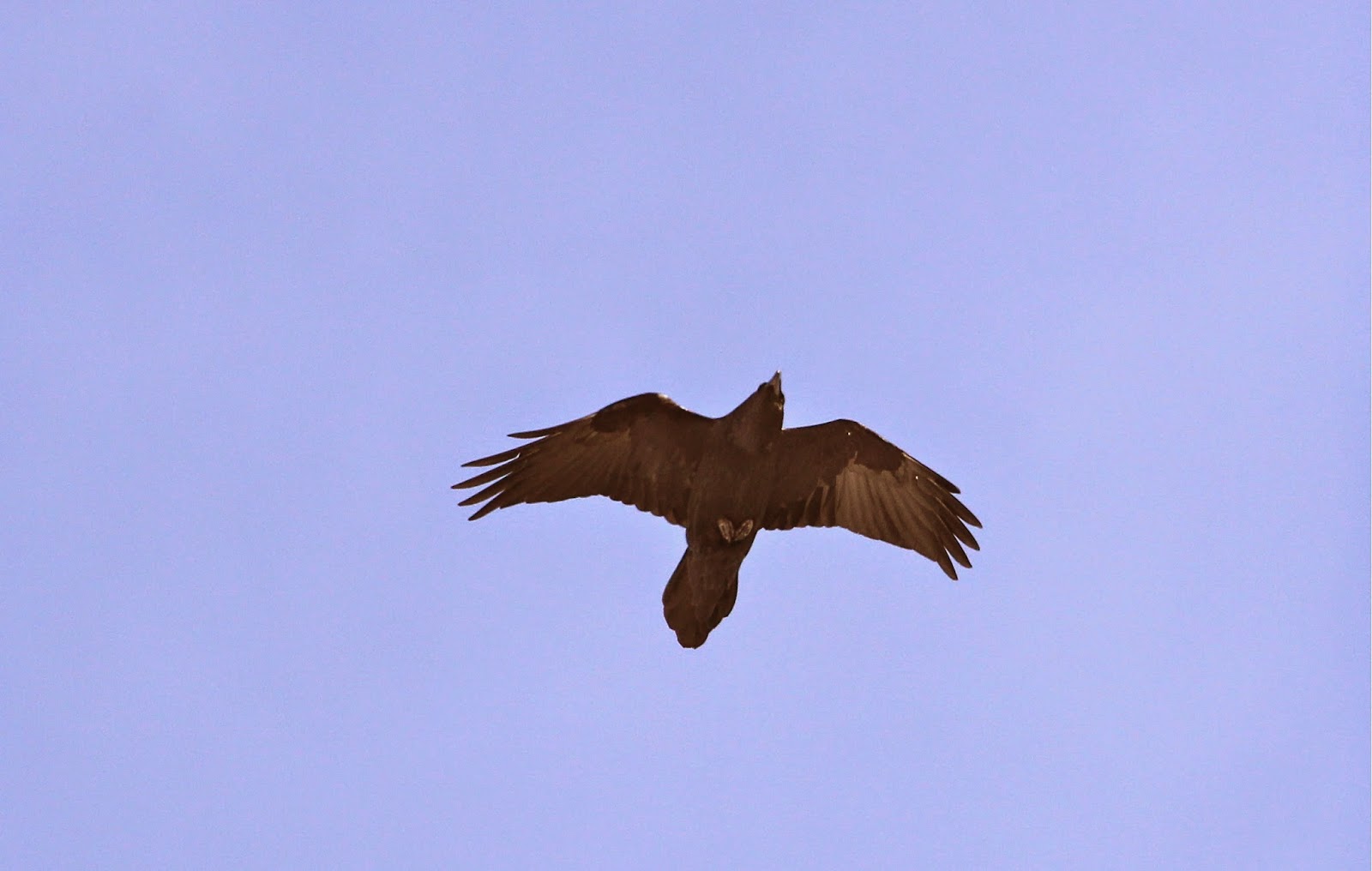
Raven made it onto the list for the first time this year, with 4 birds at Amwell giving a characteristic tumbling display. Others becoming ‘regulars’ in recent years include Ring-necked Parakeet, Little Egret, Peregrine and Yellow-legged Gull.  Caspian Gull would have been added to the list if I had bothered to stay longer watching the gull roost.

Finches and buntings have been difficult to find in any numbers in recent years but this year it is great to see that the Lee Valley Park have retained large areas of stubbles and wild bird crops around Holyfield Farm.  These areas produced 250 Chaffinch, 50 Reed Buntings, 40 Linnets, a dozen Red-legged Partridge, hundreds of thrushes and a Stonechat.

From top to bottom, the highlights were as follows:
Amwell: 4 Raven, Yellow-legged Gull, Marsh Tit, Woodcock.
Rye Meads: Jack Snipe, Shelduck, Pintail, 5 Chiffchaff, 3 Cetti’s Warblers.
Holyfield: Stonechat, Pintail, 4 Goosander, Peregrine, Little Owl, 21 Egyptian Geese.
Cheshunt GP: Bittern, 4 Smew, 6 Water Rail.

Girling Reservoir: 7 Black-necked Grebe, Goldeneye.

Monday, 30 December 2013

A bit of sniping


I recently drafted the text for Snipe for a forthcoming Birds of Hertfordshire.  A tale of woe.  Sage (1959) stated that ‘There is little doubt that the Snipe is a widespread breeding bird in suitable localities over the county’.  With the last proven breeding in the county at Rye Meads in 1998, the Snipe is now extinct locally as a breeding bird. During the 1988-92 Atlas, Snipe bred at Rye Meads, King’s Meads, Sawbridgeworth Marsh and Standon Lordship.  I knew all of these sites well when Snipe were breeding, so today I went out to take a look at what had changed.


Rye Meads looks great at the moment; nicely flooded and with lots of Snipe.  This used to be a great site for breeding Snipe but became unmanaged during the 1980s with the result that they ceased breeding.  In the early 1990s, Rye Meads was acquired as a nature reserve by the Wildlife Trust.  With management back in place, Snipe returned and up to 3 pairs bred during that decade but ceased to breed again by the early 00s.  Sawbridgeworth Marsh today also looked nice and wet, but the over-riding impression since Snipe last bred was one of changing vegetation.  Some excellent work is being put in to maintain a small area of fen meadow but overall there is a spread of coarse vegetation and scrub.   During my years at the Wildlife Trust, King’s Meads was one of the sites I put a lot of effort into acquiring as a nature reserve in the early 90s.  I remember complaining publicly that a management change by Thames Water had resulted in the loss of breeding Snipe and Garganey.  They were on the phone pronto, balling me out, but the fact remains that it happened. Today, at King’s Mead there is serious deterioration of the meadow sward; where once there was tussocky grass, Adder’s-tongue Fern and Snipe, today there is a sea of sedge and rush.  Finally, I looked at Standon Lordship, the one site in private ownership rather than a nature reserve.  The old Snipe meadow was partly under willow plantation, partly grazed to billiard table.


The reasons for the loss of Snipe at each of these sites is, in my view, as clear as the beak on its head: inappropriate management of either water or sward.  We have come to expect losses on private land through agricultural intensification but the sad truth is that, on the other side, we also have losses at nature reserves due to insufficient management.  So, back to the Snipe text and tell it how it is.  Anything we can do about the situation?  Perhaps, we shall see.

Tuesday, 5 November 2013

Tern around


Previous blogs have discussed the remarkable increase of breeding Black-headed Gulls on rafts in the Lee Valley and their interactions with the Common Terns the rafts were intended for.  There is a widespread feeling that the terns are being squeezed out by the Black-heads.  Last years total of 56 pairs of Common Terns was the lowest in the valley for some 30 years and productivity was poor.  However, this summer has seen a more encouraging picture with an increase to 72 pairs spread across four sites and with a minimum of 77 young birds fledged.   The Black-heads continued their rapid increase; from 107 to 180 pairs. The graph below shows Lee Valley nesting Common Terns in blue, Black-heads in red.


This year, a few new c-rafty ideas were tried out.  One theory has it that the gulls prefer nesting against an edge, whereas terns prefer the open spaces in the middle of the raft.   At Rye Meads, 4 normal sized 3 x 3m rafts with wire-framed side panels were locked together and put out with a new giant 6 x 6m raft with open edges sloping into the water (see pics above).  We sat back and waited.  The gulls arrived and occupied all the corners and edges of the smaller rafts, with only the last few birds settling on the large raft, and most of these nesting against the chick shelters provided for the terns. Somewhat surprisingly, the first terns settled in the middle of the gulls on the smaller rafts, with a few on the new raft.  On a group of rafts on another site, a similar pattern was noted, with the terns settling amongst gulls despite considerable space being available.  Are the terns nesting amongst gulls for protection? And balancing this against any hassle they may get from the gulls?

So the jury is still out on whether Black-heads are squeezing out terns, as long as there is enough space for both.   Try larger rafts, with Black-heads around the edges and terns in the central space.  Put at least one raft out later, just as the terns are arriving, so at least some space is available for them. Then sit back and enjoy both gulls and terns.

Sunday, 17 March 2013

Comings and goings


Despite the reluctance of winter to give way to spring, comings and goings have been evident in the last few days.  Today at Hall Marsh, where some excellent management has been undertaken by the Lee Valley Park, a Little Ringed Plover was back on territory, a Sand Martin headed north and a Chiffchaff sang from nearby bushes.


A few days earlier I had waited in vain at Amwell for a Great White Egret to return to the roost, but luckily witnessed a far more interesting event.  At dusk a Bittern drifted headed across the lake and dropped into its usual reedbed roost site. Nothing unusual there.   However, 15 minutes later, in the gathering gloom it rose out of the reedbed to begin circling up into the sky giving the little known ‘gull call’.  Within a minute or two a second bird had risen out of the reeds to join it, both dark shapes now just visible circling over the lake.  As they rose and drifted northwards, a third calling bird appeared from the south to circle the lake.  This bird disappeared high into the gloom back southwards with its far carrying call audible long after the gloom had swallowed up it’s shape. 
The ‘gull call’ can be given by both male and female Bitterns and has mainly been associated with pre-migration behaviour when birds circle up into the sky at dusk.  This behaviour is well known on the continent, where groups of up to 20 birds are noted at key wintering or passage sites.  However, the ‘gull call’ may also be heard in aerial chases over breeding sites in early spring. 


Although many of our wintering Bitterns are assumed to come from the continent, there is little firm evidence of this.  However, satellite tagging birds in the Netherlands has produced some interesting results.  Check out Anneke on this page.    Anneke was ringed in the Netherlands in 2011.  In October she arrived in the UK over Hull, toured Wales and then settled at Slapton Ley in Devon from late November to the end of February. On February 26, she flew back to the Netherlands with a stopover in East London after a flight of 900 m above the city.  Then she returned to her natal site, crossing the North Sea at over 60 miles per hour.


So our Lee Valley birds may be heading back to distant breeding areas but there is plenty of Bittern breeding activity in the UK already this spring, with a remarkable 35 booming birds in Somerset, good numbers in the north of England and some new sites occupied. With Great White Egrets also getting jiggy on at least two sites, this spring will be interesting.

Thursday, 3 January 2013

New Year thrash


Although a dry and sunny day boded well for the traditional New Year thrash through the Lee Valley, the broken rib (a Christmas present from the log-pile) somewhat slowed me down and it was more of a crawl than a thrash.   A rough tot-up showed a vaguely possible 100 species but in the end I settled for a reasonable 86 seen on the day.


High water level was the theme of the day, with brimming lakes and flooded fields. The Girling Reservoir was as full as I can remember it and typically, once the gulls had departed at dawn, there were very few birds left.   Most of the Black-necked Grebes also seem to have departed, with only 6 noted.  A Chiffchaff along the Girling fence was an unexpected bonus.  Further up the valley, just 5 Smew are around this winter so far, but Bittern number 6-7, of which I managed a couple – at Cheshunt and Amwell.


The long-staying drake Scaup and Long-tailed Duck may seem to be the highlights of the day but they were probably eclipsed by Hawfinch and Lesser Spotted Woodpecker, the first time I have seen both species locally on a day count for many a year.  Pleasingly, the Hawfinch was added in my valley-side garden during a breakfast stopover, with up to three being noted in recent days.


Although water birds are generally in good numbers in the valley, it is the dearth of seed-eating farmland birds that is a problem.   There seems to be virtually no flocks of finches in the valley any more, but given that weedy areas on farmland or around mineral workings have all but disappeared this is not surprising. So while Red Kite, Little Egret and Peregrine now almost put themselves on the list, partridges, linnets and Yellowhammers take some searching out.

Friday, 28 December 2012

Don't tell him Pike


I saw my first Bittern in Nightingale Wood in 1972.  The London Bird Report has it as:  Cheshunt GP, one on Mar 4th (GJW).  Hmm, rather brief for what I seem to remember was a good find at the time.   However, over the years this has become a regular haunt for wintering bitterns.  So why do Bitterns return to this spot year after year?

Nightingale Wood is a wonderfully scruffy few acres of wet self–set woodland on the edge of a badly restored gravel pit.  It’s landform is varied to say the least: hollows, holes, slopes, cliffs, pools and piles of reject gravels.  Initially colonised by Hawthorn and willow scrub but now succeeding to Ash and Alder, with masses of dead wood. The modern mineral planning officer would never allow it.  They would smooth everything out, cover in top soil and insist on regimented rows of planted trees, and in doing so would eliminate any decent habitat.

Nightingale Wood? I hear you say.  Well yes, once upon a time in the scrubby days, 2 or 3 pairs were to be found.  I found my first Nightingale nest in this wood and watched the youngsters fledge.  Many a Willow Tit nest was also noted.  Over the years the wood has provided regular Woodcock, Water Rails, Siskins and Redpolls , but also 3 Golden Orioles, 2 Firecrests, 2 Wood Warblers, Pied Flycatcher, Great Grey Shrike, Bearded Tits and a roost of 9,000 Fieldfares one night.  The edge of the wood grades into the water-filled pit through tumble-down wet woodland and marshy spits to a reedbed fringe of about an acre.

This is where the Bitterns come in. So why do Bitterns return to this spot? The varied topography of the wood continues out under the water with deeper pools interspersed with reedy shallows.  Research papers will tell you that Rudd and Eels are the preferred prey of breeding birds in the UK, but Perch and Pike aplenty tuck into these watery hollows in the reedbed during the winter and form the main prey for Lee Valley Bitterns in the lean months. Good feeding at this time of year is crucial for getting the birds through the winter and into good condition for breeding.

I returned to Nightingale Wood yesterday for an hour or so at dusk and a couple of Bitterns were on show.  There are currently 7 or 8 Bitterns wintering in the Lee Valley, with 5 in the Cheshunt pits complex.  The reedbed now has excellent viewing rides cut into it by the Lee Valley Park Authority.  One Bittern duly appeared on the edge of a reedy ride no more than a dozen paces from my original sighting in ‘72.   It caught a nice stripey Jack Pike and soon dispatched it.  At dusk both birds moved with just a brief few wing-beats from the feeding spots to the safe roosting areas on the edge of the reedbed.   That’s why they come back here.

Monday, 17 December 2012

In the beginning.......there were LRP's


 As December ticks away, I eventually get to the task of sorting out the years records from the notebook.  If only I was a little more organised.  This week’s task was to complete the analysis of one of my regular breeding bird surveys; at Amwell Quarry (now nature reserve).  The run of data on breeding birds for this site now extends back to the late 1970s when mineral extraction began.  Why have I done this for 35 years?  Who knows, it just happened.


Eighty species have bred at Amwell over those years, 46 of them managing to enter the ‘scoresheet’ for 2012.  This is somewhat below the 53 species in the best year; 2001.  These 46 species amounted to a total of 327 pairs of birds, again somewhat below the peak of 410 pairs in 2002.  So the headline story is somewhat of a rise and fall.  However, as you would expect, these figures hide the many changes over the years.  A number of species, such as Willow Warbler, Yellow Wagtail (5 pairs in 1983), Turtle Dove, Linnet and Tree Sparrow, have all declined more or less in line with national trends.  But without doubt, the major influence has been successional changes in the habitats, with meadow, marsh and mud being replaced by reed and willows. 


These changes have, of course, produced a number of winners: Grey Herons and Cormorants in the trees, recently joined by Little Egrets, and Reed Warblers, Cetti’s Warblers and Blackcaps in the reed and scrub.  In addition, Black-headed Gulls and Common Terns have used the rafts provided.  The losers have been the grassland birds of the old meadows and more significantly the variety of wildfowl and waders.  Tufted Ducks peaked at a massive 62 broods in 1987 but have since dropped away to low single figures.  Likewise, Gadwall rose to a peak of 12 broods before dropping to just one and after peaking at 53 pairs, Sedge Warblers have dwindled to just 14 as habitats have changed.


Wading birds, particularly the Little Ringed Plover, have always been a key feature of the site since the mineral extraction began.  LRPs peaked at 8 pairs but with numbers rising and falling in relation to the amount of habitat.  Despite the recent addition of Oystercatcher in recent years, LRPs and waders in general, are now teetering on the edge of disappearing as breeding birds.   The problem is that the relentless march of reed and other vegetation across the formerly open areas outpaces the management effort.  What is needed, what most old gravel pits need, is a bit of Localised Intermittent Catastrophe.  A combination of controlled vandalism with a large digger and some dynamic water management should help knock selected areas back to an earlier stage in the succession so the process can start again.  We gathered on site this autumn, umm-ed and arr-ed a bit, and some good work was subsequently undertaken, but on reflection, much more of the same will be required if LRPs are to remain until the end.

Below - Amwell 1987 (8 prs of LRP), Amwell 2012 (none).