Showing posts with label Minsmere. Show all posts

Saturday, 11 August 2012

Antlion antics

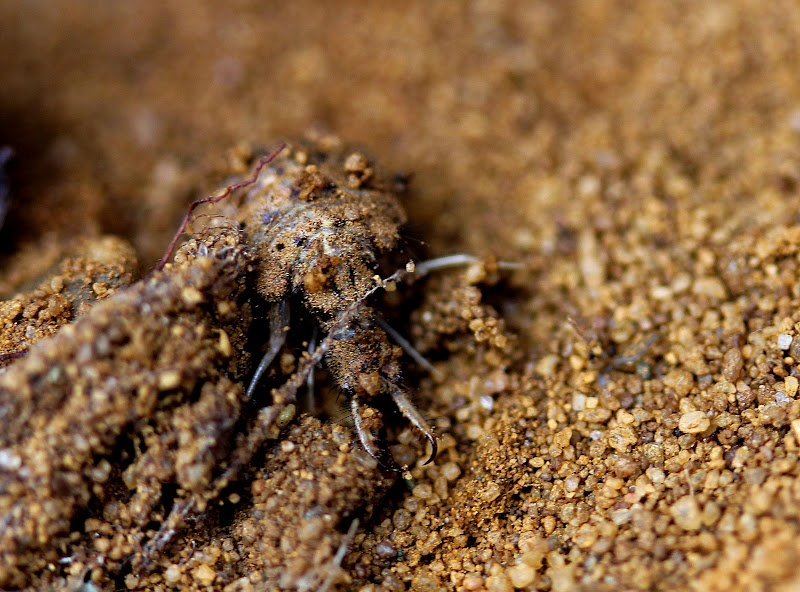
Antlion larva

With perfect timing some good weather at last arrived as we embarked on an assessment of invertebrate habitat at Minsmere this week.  Overall, there is a good diversity of habitat on this section of the Suffolk coast but the increasing numbers of Red Deer and the impact of their trampling and browsing is a concern in some areas. The trip turned into a bit of a general bio-blitz, with a good range of local specialities logged over a couple of days.


Antlions are one of those local specialities, with their characteristic larval pits even being found around the visitor centre walls.  We concentrated our search down at North Warren where a concentration of 1000+ pits had been counted earlier in the season.  Many had been washed away by recent heavy rain but a good number remained. The sand at the bottom of the pits conceals a ‘Doctor Who’ monster of a larva.  As soon as a couple of ants were ‘persuaded’ to wander around the pit edge, a deadly flick of sand knocked them down to the waiting jaws.

Plenty of Grayling and Silver-studded Blue butterflies were on the wing across the heathland, a long list of bees was steadily accumulated, and each gorse bush seemed to be home a few of the widespread Labyrinth Spider Agelena labyrinthica; their large sheet webs with a tubular retreat being very obvious.  Natterjack Toads have had a good year with thousands of tadpoles being seen earlier in the year despite the ponds being rather churned up by deer.  More by luck than skill we came across a toad posing nicely within a hollow.  Nearby we found the large Robber-fly Eutolmus rufibarbis.  This splendid beast is a scarce species of southern heathlands, especially Breckland.  It lays its eggs in slits in plant stems, with the emerging larvae entering the soil and predating dung beetle larvae.  A number of scarce plants were encountered, Red-tipped Cudweed, the diminuative Smooth Cat’s-ear, Mossy Stonecrop and two species of Catchfly: Sand and Small-flowered.  Both had just finished flowering but were still readily identifiable from the developing seed capsules.

We tried not to look for birds but managed to see a few Stone Curlews and it would have been rude not to watch the group of four Spoonbills that circled, landed and fed in front of us.  These were no doubt some of the 12 or more Spoonbills currently loafing on the Suffolk coast and includes a 2011 German-ringed nestling which spent last winter on the Essex coast.  Stone Curlews have had a moderate year.  Five chicks have so far fledged from the ten pairs in the Minsmere area.  These birds generally choose undisturbed areas well away from public access but this year one pair settled close to the visitor centre, with volunteers posted at a suitable vantage point to point them out to visitors.   


Saturday, 29 October 2011

Island Mere in ruddy health


Rudd (top), Roach and the new Island Mere hide.  Note head shape and mouth structure of the fish.

Electro-fishing the Island Mere at Minsmere usually has to be a quick affair so as not to upset too many visitors. However, this week it was more leisurely as it is closed to visitors while a new island mere hide rises from the marsh. The hide traditionally provides excellent views of Bitterns on the edge of the mere and it was along these margins and in the adjacent ditches that we concentrated the fishing effort. The results were spectacular – an estimated fish biomass of 74 kg/ha - one of the best recorded at Minsmere. Roach formed the bulk of the biomass, but with significant increases in Rudd and Perch. Tench, 3-spined and 9-spined Sticklebacks made up the remainder of the catch.

Research has shown that Rudd are a major food source for breeding Bitterns whilst Roach are less important. Why should this be for two apparently similar fish? The answer probably has to do with differences in their behaviour. During the daylight hours of the summer months, Rudd tend to hide amongst the reedy marginal vegetation, thus making themselves easier to catch by Bitterns. By contrast, Roach spend more time out in the open water amongst weeds and away from the margins. However, in the winter months, both species move into deeper, more sheltered ditches and Roach are likely to be more available to feeding Bitterns. Given good water levels in the spring, the signs are good for breeding Bitterns next year.


Earlier in the week, on another site, I looked at the nesting site of a pair of Cranes. They can be remarkably secretive in the breeding season and tend to choose a secluded nest site surrounded by shallow water. The nest often looks out over a small clearing in the wetland where they can see the approach of predators. This particular nest clearing is growing over fast and work will be required this winter to open it up a little. However, whilst the young chicks will feed around the nest, it is the quality of the wider foraging area that will determine the likelihood and speed of the chicks fledging. Invertebrate-rich, tall vegetation, preferably in wet (squidgy) conditions is a key requirement.

Wednesday, 21 September 2011

Scrapes, plums and flaming O's


Probably not the most popular person yesterday as I collected samples of invertebrates from the scrape at Minsmere.  A flurry of birds and all were gone - apart from a couple of tame Pec Sands and 'Fiona' the Flaming O.  The invertebrate samples will help inform management, providing further information on the food resource available to birds in water of differing salinities.  More on this when the results are in.  A couple of Whimbrel and a fly-by Curlew Sandpiper added interest.

Back onto the path and the scrape-side bushes were dripping with ripe plums. There seems to be a bewildering array of ‘wild plums’ to be found in our hedgerows. Fruits of differing sizes and ranging in colour from yellow and red through to purple. The plum is thought to be the result of hybridization between the Sloe Prunus spinosa and the Cherry Plum Prunus cerasifera. Such hybrids and an array of back-crosses fall under the Wild Plum Prunus domestica heading, with various forms or subspecies. These late-ripening fruits at Minsmere seem to fall into the 'Bullace' category (P. d. insititia).  In a minute or two, enough were gathered to produce a tasty Wild Plum Frangipane - just like this.

Thursday, 14 October 2010

Right place. Right time.


Sub-dividing the east scrape at Minsmere should allow for better water control and help to alleviate the early drying of recent summers.  Lower: a ridiculously tame Red-flanked Bluetail photographed with my mobile phone.

Just occasionally work is in the right place at the right time. This week was one of those times. A review of the scrapes at Minsmere has identified some changes to improve the hydrology. I stopped off to look at how work was progressing, with the added bonus of the King Eider bobbing up and down off-shore. Then, on to the Hickling area to take a look at Bittern and Crane nesting locations. Nearby, a highly successful reedbed restoration project was undertaken by the Norfolk Wildlife Trust nearly ten years ago. Commercial reed-cutting is often considered incompatible with conservation objectives by site managers. However, I have never gone along with this view and Hickling shows how this can be achieved through a careful mix of commercial (short rotation) and conservation (longer rotation) reed-cutting. The key issue for Bitterns is the need to reduce water levels for reed-cutting in the early part of the year (Jan-Mar) at just the time when they require higher water levels to provide good feeding conditions to bring them through the winter and into breeding condition. However, cut compartments are favoured by nesting Cranes and a mosaic of cut and uncut blocks are ideal for Bearded Tits.

Stunning views of two birds at nearby Waxham rounded off an enjoyable couple of days – a Pallas’s Warbler hovering 3 metres in front of me and a Red-flanked Bluetail feeding around my feet.

Saturday, 12 June 2010

Cudweed central

Red-tipped Cudweed, Spoonbills (including a Dutch-ringed bird) and an ant in trouble in an Antlion pit.


A chance to stand back and assess progress is a valuable exercise in nature reserve management. The heathland and acid grassland habitats at Minsmere were the focus of attention this week. Undoubtedly the reversion of ex-arable fields to acid grassland has proved highly successful for Stone Curlews with around 8 pairs in the wider area, and is also a hotspot for cudweeds, including the endangered Red-tipped Cudweed. Following the severe winter, Dartford Warblers have not suffered as badly as feared in Suffolk (with about a 40% decline).

A trip to Minsmere always provides plenty of interest: a Purple Heron lurked in the reedbed, Avocets appear to be having a good year on the scrape, Black-headed Gulls have increased to around 1500 pairs (with a few pairs of Med Gull) and a pair of Spoonbills frequented the Levels all week. Last but not least, Antlion pits around the visitor centre proved great entertainment. As ants slip into the pit the Antlion larvae flick sand up to dislodge them until they slip into the waiting jaws.