Showing posts with label Spoonbills. Show all posts

Saturday, 11 August 2012

Antlion antics

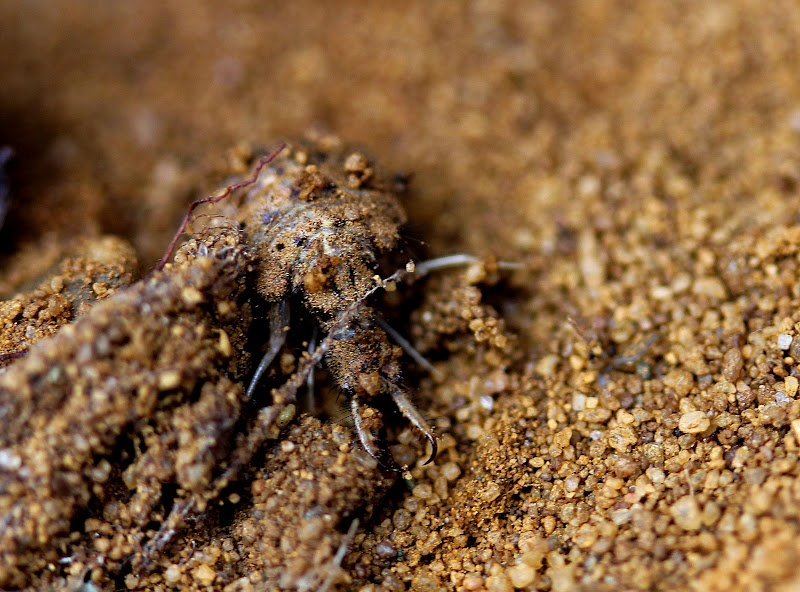
Antlion larva

With perfect timing some good weather at last arrived as we embarked on an assessment of invertebrate habitat at Minsmere this week.  Overall, there is a good diversity of habitat on this section of the Suffolk coast but the increasing numbers of Red Deer and the impact of their trampling and browsing is a concern in some areas. The trip turned into a bit of a general bio-blitz, with a good range of local specialities logged over a couple of days.


Antlions are one of those local specialities, with their characteristic larval pits even being found around the visitor centre walls.  We concentrated our search down at North Warren where a concentration of 1000+ pits had been counted earlier in the season.  Many had been washed away by recent heavy rain but a good number remained. The sand at the bottom of the pits conceals a ‘Doctor Who’ monster of a larva.  As soon as a couple of ants were ‘persuaded’ to wander around the pit edge, a deadly flick of sand knocked them down to the waiting jaws.

Plenty of Grayling and Silver-studded Blue butterflies were on the wing across the heathland, a long list of bees was steadily accumulated, and each gorse bush seemed to be home a few of the widespread Labyrinth Spider Agelena labyrinthica; their large sheet webs with a tubular retreat being very obvious.  Natterjack Toads have had a good year with thousands of tadpoles being seen earlier in the year despite the ponds being rather churned up by deer.  More by luck than skill we came across a toad posing nicely within a hollow.  Nearby we found the large Robber-fly Eutolmus rufibarbis.  This splendid beast is a scarce species of southern heathlands, especially Breckland.  It lays its eggs in slits in plant stems, with the emerging larvae entering the soil and predating dung beetle larvae.  A number of scarce plants were encountered, Red-tipped Cudweed, the diminuative Smooth Cat’s-ear, Mossy Stonecrop and two species of Catchfly: Sand and Small-flowered.  Both had just finished flowering but were still readily identifiable from the developing seed capsules.

We tried not to look for birds but managed to see a few Stone Curlews and it would have been rude not to watch the group of four Spoonbills that circled, landed and fed in front of us.  These were no doubt some of the 12 or more Spoonbills currently loafing on the Suffolk coast and includes a 2011 German-ringed nestling which spent last winter on the Essex coast.  Stone Curlews have had a moderate year.  Five chicks have so far fledged from the ten pairs in the Minsmere area.  These birds generally choose undisturbed areas well away from public access but this year one pair settled close to the visitor centre, with volunteers posted at a suitable vantage point to point them out to visitors.   


Thursday, 7 July 2011

Spoon-fed

Feeding Spoonbill pictures taken by John Bottomley at Titchwell. 

The Wadden Sea islands are remarkable for both migrant and breeding birds. Texel, at the southern end if the chain, is perhaps the best known to birders and has high levels of conservation management involving terns, waders, plovers and Spoonbill.

One key fact is that the island has virtually no mammalian predators, just a few Stoats. This was clear at our first stop; a Sandwich Tern colony of some 1200 pairs, on easily accessible spits and islands but full of chicks. The next stop was one of two Spoonbill colonies on the island, one amongst scrub, the other in saltmarsh, but both on the ground.

Spoonbills have been increasing in the Netherlands since the 1980s. There was an expansion into the Wadden Islands after the colonies at Oostvaardersplassen moved when the site was dried out for some years. The two colonies appear to feed principally on different food. The 'scrub' colony feeds on sticklebacks, with birds foraging principally on the Dutch mainland many miles away. The saltmarsh birds feed on prawns in the Waddensea. The Dutch have developed specialised sluices to allow spring-running Three-spined Sticklebacks to enter freshwater from the sea. This forms a key early food for Spoonbills, as discussed in a previous blog. Prawns increase in size and abundant later in the season and thus the saltmarsh colony breeds later.

So what do we need to get Spoonbills established as a breeding bird? A large wetland nesting site, secure from predation and disturbance, and large food-rich shallow wetlands. Birds may travel many miles between these sites.

Wandering on through dunes we saw numerous Bluethroats (60 pairs on Texel), Bittern (5 boomers in dune pools), abundant Marsh Helleborine and Fen Orchid of the subspecies ovata, with its more oval, hooded and erect leaves. Kentish Plover previously nested here but are now declining in The Netherlands, with the population down to c200 pairs, mainly in the delta region. The habitat looked good and was extensive but human disturbance is a problem.

A newly created scrape held many Little, Common and Arctic Terns, as well as 100+ pairs of Avocets. With increasing pressure on beaches, this is exactly the sort of conservation action that is required for our terns. Nearby we looked over a saltmarsh wader roost, holding 10,000+ each of Curlew, Oystercatcher and Knot, and 20,000+ Bar-tailed Godwits.

Thursday, 2 September 2010

Starlet steals the show

View across Havergate (with 14 Spoonbill), Avocets arriving at high tide, Starlet Sea Anemone - a rare specialist of coastal lagoons.

Equipped with sifting trays, nets and a supply of red wine, I had Havergate Island to myself for two days. The aim was to undertake a survey of the saline lagoon fauna but with a light easterly blowing, I was hoping for more.


Famous as 'Avocet island', recent years have seen a dramatic change in bird populations on the island. From zero a few years back, the island now supports 1200 pairs of LBBG and 600 pairs of Herring Gull. The increase in gulls has resulted in a corresponding decrease in breeding Avocets, Ringed Plovers and terns, due to predation. The gulls have moved to Havergate from Orfordness, where they have been decimated by Fox predation. However recent years have also seen an increase in Spoonbills, with counts here or at the adjacent Orfordness being the UKs highest, 14 were still present during the visit.

The lagoons at Havergate are also important for their specialist invertebrates. The sampling revealed a high biomass within most lagoons; ragworms, the amphipod Corophium, Lagoon Cockles and abundant Palaemonetes shrimps, but perhaps the most important saline lagoon specialist is the Starlet Sea Anemone. However, with a body only 2-3mm long, this is not the most obvious beast.

Avocets still favour Havergate for feeding, 620 were present, along with 250+ Redshank and 50+ Black-tailed Godwits. Other bird highlights included 50 Common, 26 Sandwich, 1 Arctic and 1 Black Tern, Peregrine, Hobby, 3 Pintail, 15 Greenshank, 2 Spotshank, 10 Knot, 60 Golden Plover and 28 Bar-tailed Godwit. Passerine migrants were represented by a Reed Warbler, a few Wheatears and a Rock Pipit. Could have been better, but the sunset was worth it.


Wednesday, 11 August 2010

Can a Corophium make a spooner randy?


Top: arriving at Havergate, Middle: Corophium volutator, Lower: a pair of smug post-breeding Spoonbills.

A break from ecological desk-work saw us discussing Spoonbills on Havergate Island. Havergate Island is one of my favourite sites, always with something to see. The island has hosted the largest UK gathering of Spoonbills for several years, with 15 present at the moment, down from the peak of 19 this year, but with up to 26 in recent years.

The recent news that Spoonbills have bred in Norfolk was a bit of a blow. Personally, I’m gutted. We have been trying for years to get them to breed on the island.

As in many species, when it comes to breeding, it appears that food is the key limiting resource. Spoonbills breed when their primary prey reaches abundance. Food intake is determined by the catch frequency and increasing prey weight increases the food intake rate but..... the average catch frequency decreases with prey size. With me so far?

A Spoonbill can sweep and catch up to 20 food items a minute, but at this rate the items will be small (such as the small crustacean Corophium), enough to keep a Spoonbill going but not enough to bring it into breeding condition. However, Sticklebacks ‘running’ from the sea into estuaries or lagoons in spring to breed are a different matter. Spring Sticklebacks have a high calorific value – they are nice and fatty. Catching one or two of these a minute is better for a Spoonbill than sweeping at full rate to catch 20 small food items. Sticklebacks migrating from the sea to breed are a key food item for returning Spoonbills in The Netherlands. Shrimps, especially Palaemonetes varians are also a favoured food item, but they only reach a reasonable size later in the season. The strategy at Havergate has been to try and maximise the primary food resource for the returning adults in April.
Oh well, perhaps next year.