Showing posts with label Garden. Show all posts

Sunday, 27 January 2013

Big Garden Birdwatch


Okay, maybe it’s an age thing, but I did the Big Garden Birdwatch this year.  Well, it takes me an hour to walk from the house to the car these days (poor feet not big garden), so I might as well do something useful on the way to somewhere better.  I recorded a total of 25 species feeding in the garden during the hour.   I have 3 large seed feeders (nyger/sunflower), fat ball feeders and lots of ‘apple trees’ (half apples spiked onto branches).  Tits dominate by far, Great and Blue Tits are near impossible to count but there are easily 25-30 of each at any one time.  Several Coal Tits are regular and a single Marsh Tit has been visiting frequently all month and duly put in an appearance. 

The ‘apple trees’ are a great hit.  Jays, Jackdaws and thrushes love them.  Even the Blue Tits regularly feed from them.  Single Mistle Thrush and Fieldfare have each ‘guarded’ an area of apples during the cold spell.  The local Sparrowhawk regularly raids the feeders about twice a day.  It deters the tits for a minute or two, but then the flight-line resumes.  It’s a bit like a speeded up arrival at Heathrow; look into the garden and Blue or Great Tits are descending from the large tree to the feeders every few seconds, one after another.  Unlike Heathrow, they increase their arrival rate in the snow.  A quick wait on the arrival branch, onto a spare perch on the feeder, and then away.

I’ve been in this house for about 9 months now.  The commonest bird in my last garden was Redpoll, with up to 40 on and around the nyger.  Greenfinches were the commonest birds on the sunflower feeders.  Just 11 miles away, the avifauna of my new garden has a very different feel.  No Redpolls, very few Greenfinches and zero House Sparrows or Starlings.  Although both gardens are located close to woodland (then Epping Forest, now Broxbourne Woods) the current garden has far more woodland birds, with Nuthatches, Green and Great Spotted Woodpeckers all visiting daily.  However, the highlight of the new garden has been the occasional visits of up to three Hawfinches over the last month. One briefly appeared in a tree at the end of the garden yesterday, but they have failed to come down for seed so far.

Count completed, I did then sneak out for a quick look at the nearby Caspian Gull.  Oooo don’t you just love those tertials?  Hmmm maybe not that much.

Pics above: Marsh Tit, Nuthatch, a busy day on the feeders, Blue Tit on 'apple tree'.

Tuesday, 22 May 2012

The clearing infested with snakes


Grass Snake and Ramsons

With the dust barely settled after the recent house move, I’m beginning to get a feel for the new surroundings.  The feeders are out in the garden and the list is up to 40; Green Woodpeckers and Nuthatches every day are a bit of a novelty so far.  House Martins have returned to old nests under the eaves.


Just beyond the garden, Wormley Woods stretches in all directions.  ‘Wormley’ apparently is derived from the old English word meaning ‘the clearing infested with snakes’.  The ‘Woods’ themselves are considered the best UK example of Sessile Oak-Hornbeam woodland, a stand-type found on acidic, well drained soils. The ground flora of such woods is often poor, with abundant bramble, bracken and honeysuckle but little else.  However, some specialities do occur; Wild Service Tree, Great Wood-rush and Golden-scaled Male Fern.  The woods have a series of deeply cut streams running through them, many of the flatter areas swathed in Ramsons and Golden-saxifrage.  These were the woods of the Redstart, Hawfinch, Nightjar and Woodcock in Hertfordshire, now all thin on the ground or gone. The snakes are still there though.


The first trips out into the local patch have not been that exciting. Woodpeckers, Nuthatches and a few flyover Crossbills, which appear to have bred locally.  Today was a better day though; a calling Lesser Spotted Woodpecker and a fly-over Honey Buzzard.  The decline in Lesser spots has been attributed to low breeding success, with a lack of food being a possible cause.  The disappearance of one of the adults, often the female, is suggested as the cause of failure, with the remaining parent failing to bring in enough food.  Female Lesser spots have been shown to have lower survival compared to males and their disappearance may be an adaptive strategy, but it fails to work if the male cannot up the provisioning rate to match that of two birds.

Tuesday, 21 February 2012

Yucca fails to prevent Egyptian triumph


A garden bird list is a reasonable antidote to those days when you are stuck indoors or have to work at home. My rules are simple. I have 2 categories: landed in garden or flyover. If I can see or hear it from the house or garden, it’s on the list.


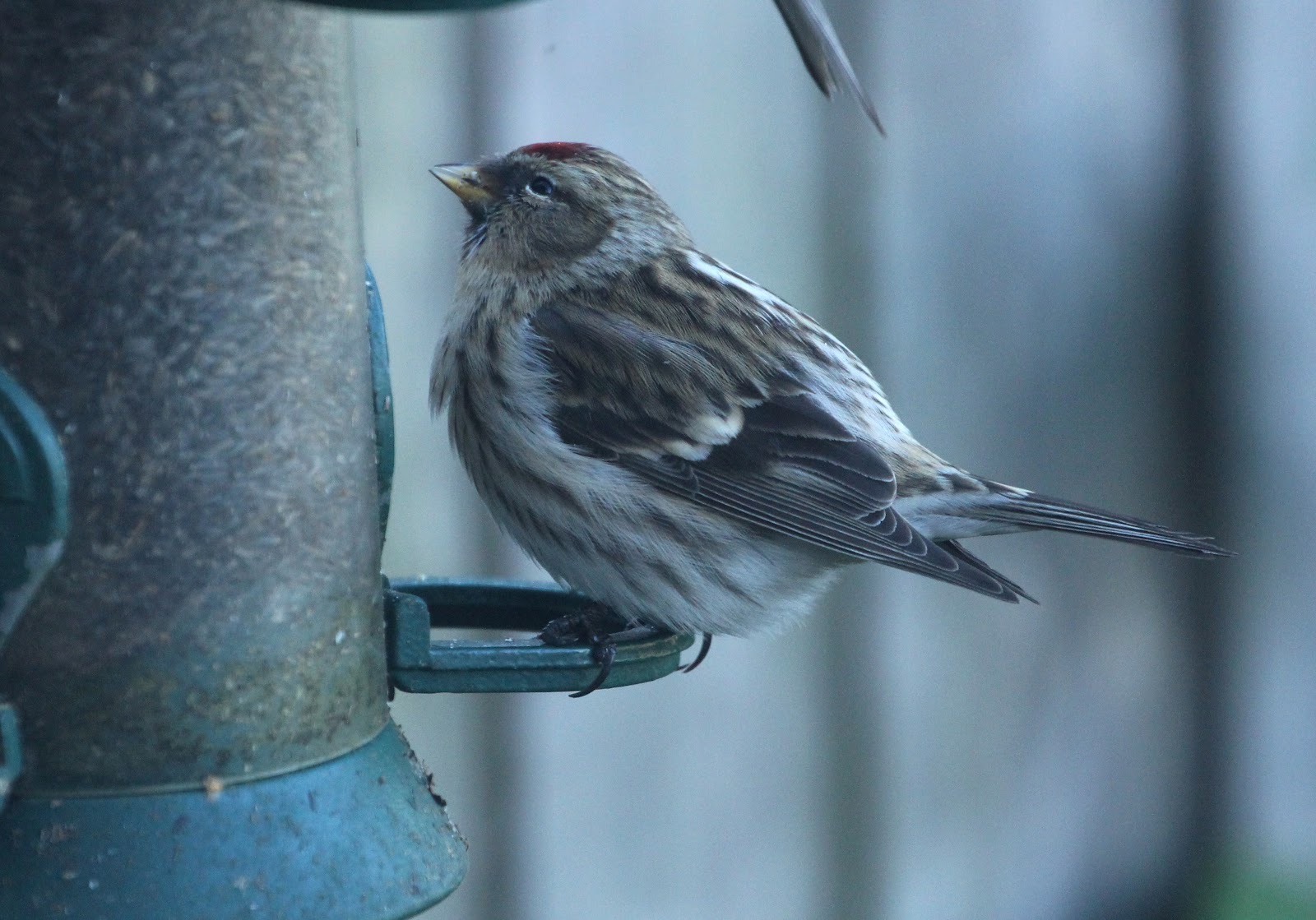
Over the past three winters, I have been nurturing an ever increasing flock of Redpolls, focused around a couple of nyger seed feeders. They twitter away all day long outside the window. At peak, 35-40 are around at once. As usual, there is an interesting array of plumage variation. Most, of course, are Lesser Redpolls, but if you take the following to be characteristics of Mealy Redpoll: grey-brown upperparts, greyer head with whitish nape collar and ‘bulging’ neck, strong white wingbars, a pale streaked rump on a white background which bleeds white into the surrounding flanks and lower back, whitish underparts and undertail coverts (some with arrow-shaped dark centres) and a long primary projection, then I have a few that fit the bill.

Unfortunately, my garden is rather dull. Redpolls are by far the commonest bird. However, if I lean out of the upstairs window on one leg and view sideways between two distant houses, I can see a sliver of the village pond. Recently, I noticed an Egyptian Goose on the pond as I drove home. A skid onto the drive and a quick run upstairs, followed by nearly one hour on one leg peering sideways and it swam across the sliver of view. Result. The problem is that the occupants of one of the above mentioned houses has an increasingly large Yucca tree growing in the crucial gap and the sliver of view is declining year on year. A midnight raid with a bowsaw has been considered, but the more obvious answer is to move. So sadly, we are leaving our glorious view over Epping Forest in the Land of Spray tan and Bling and heading to pastures new. With this momentous decision made, I got another new garden bird: a Heron came and ate all my frogs.