Friday, 16 September 2011

Extreme vis-migging


Lower pic - the Lee Valley from Tower 42 - Walthamstow, the Girling, the George and beyond.

I’m not keen on heights but as Tower 42 is now only the 5th tallest building in London, at 600 feet, I thought I’d give it a go. We clambered up various steps and ladders onto level 47, the very top, with a splendid all-round view of London for a session of watching for visible bird migration over the city.

Everything looks very small from up there!  No doubt, the more eyes looking the better, but in 4 hours we recorded the following: 22 Lesser Black-backed Gull, 4 Buzzards, 3 Kestrels, 4 Sparrowhawks, 2 Peregrines, 5 Cormorants, 1 House Martin, 10 Swallows, 1 green balloon, 1 blue balloon, 1 Tesco bag and 5 flies.

An excellent morning that showed the potential if you could hit the right day. Many thanks to David Lindo for organising it all (as detailed here) and to the tolerant Tower 42 security guys for putting up with us.

Tuesday, 13 September 2011

Chipirones and carrots


The top priority as we pulled into Sant Carles de la Rapita was a plate of chipirones (fried little squid) and a cold beer. A plate of razor clams drizzled with oil and lemon soon followed, oh and some octopus 'a la plancha' of course. Several hundred Swallows moved south past the front of the harbour-side bar as we swallowed. The first of many Audouin’s Gulls drifted by. Another plate of chipirones? So started our weekend seafood extravaganza in the Ebro Delta in Spain.

After a long lunch we drifted out into the delta to work up an appetite. Rice fields everywhere; the wet harvested areas full of egrets and herons. Most of the delta is now given over to rice production but there are a few protected areas of wetland (but many are privately owned by hunters) that support tens of thousands of waterbirds. The brackish La Tancada lagoons held 300+ Greater Flamingos and many passage waders; Little Stints were everywhere and Kentish Plovers dotted about.

L'Encanyissada is a large shallow freshwater lake surrounded by reedbeds. Hundreds of duck, including Red-crested Pochard, and another 200+ Flamingo formed the main birdy backdrop. At least 150 Whiskered Terns hawked back and forth along the margins or perched on every stick that stuck out of the water. Little Bitterns and Squacco Herons flew hither and thither. A flock of 8 carrot-beaked Caspian Terns arrived in front of us. As dusk drew near, Night Herons appeared miraculously all around and straggling flocks of Purple Herons rose out of the reeds. Stomachs began to rumble. We were soon into the main event; sucking the juicy brains out of Mediterranean Red Prawns, slurping more clams out of their garlicky shells and working through a huge pot of mixed fishes in fishermans sauce thickened with a garlic and almond picada. Yum. A fine Rioja eased their passage.
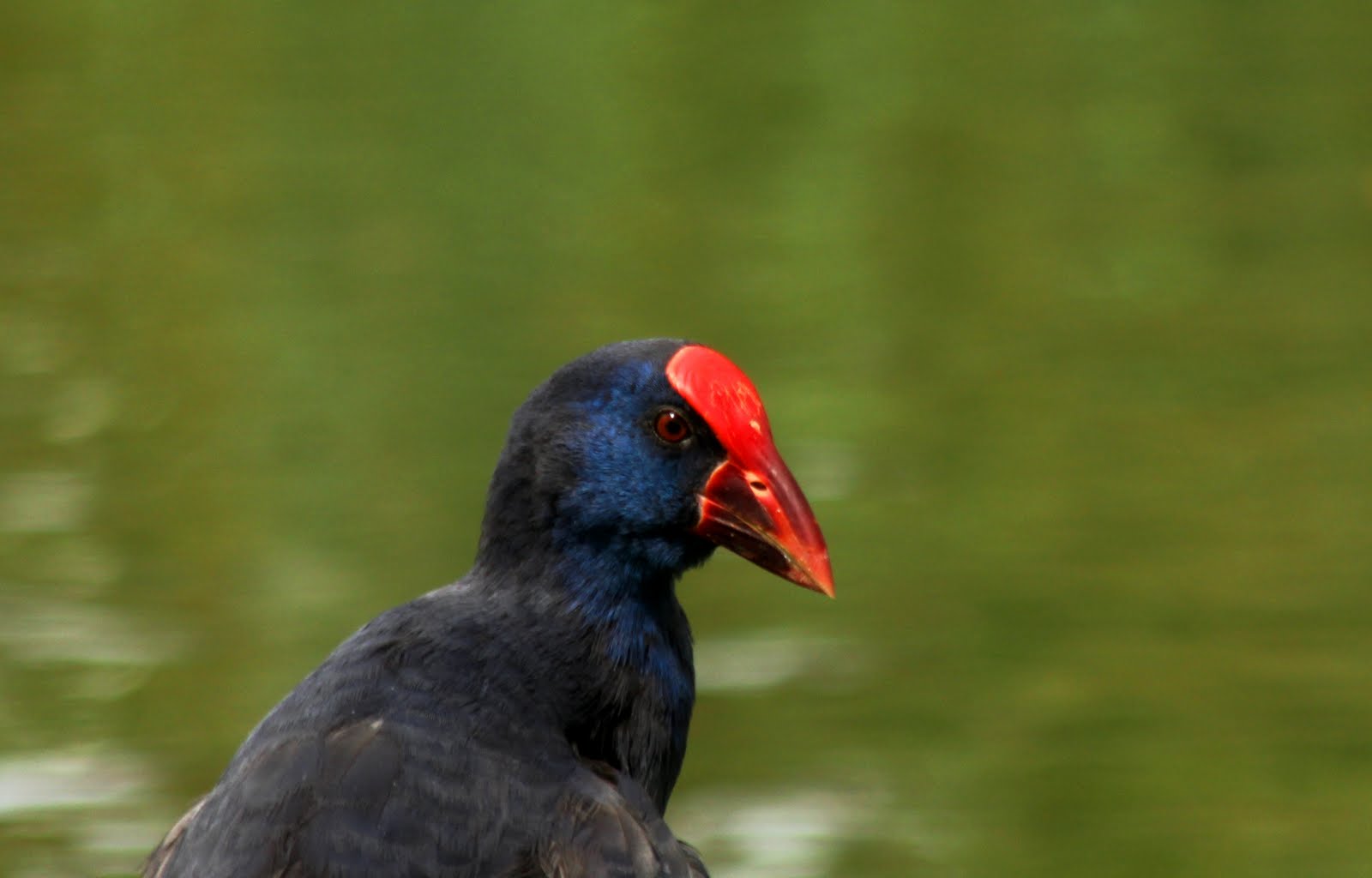
The following morning we headed out to Riet Vell, where the SEO (Spanish Ornithological Society) have a site than produces organic rice. The harvested fields were left wet and held many waders; Temminck's Stints, Wood Sands, Curlew Sands, Greenshanks and LRPs were the most numerous. A quick look from the hide overlooking the reedy lagoon resulted in an eye to beak meeting with a Purple Gallinule.

Zig-zagging through the rice fields we arrived at El Garxal lagoon. Hundreds of terns (Common, Little and Sandwich) congregated along the shoreline, along with more Whiskered and another couple of Caspian Terns and many Med Gulls. Three flocks of Glossy Ibis, totalling around 200 birds, arrived off the sea and headed inland. Fan-tailed Warblers zitted up and down and Sardinians rattled. A Praying Mantis obliging sat on my finger, wondering if I looked like dinner. Dinner did you say? We eased back to a restaurant on the edge of some marshland. Is that a Moustached Warbler in front of those Penduline Tits? Never mind, here come the langoustines with green beans and basil (steady, that's enough of the vegetables), then the clams, the smoked eel and yet more crispy yet succulent chipirones.

Swallows continued to flood south, now joined by increasing numbers of Sand Martins, as more seafood headed in the same direction, washed down with a nice chilled Cava. More Audouin’s Gulls floated by. Sea Cucumbers anyone? A great weekend, shame we didn't have more time, I didn't try the oysters.

The full list:
Squid, cuttlefish, octopus
3 species of prawn
4 species of clam, including razors and tellins
Mussels
A spikey-shelled whelky-type thing
Eels
Hake, sole, monkfish, salt-cod, anchovies, sardines, fried baby fish.


Wednesday, 7 September 2011

Omophron beach


A good day: Omophrons, Lycopodiella, Bog Bush-cricket and Nike Air.

Mark, normally a docile sort of ecologist, has taken just a few paces onto the site before he kicked some water up from the small lake onto the adjacent sandy beach. The peace and quiet was broken by "f*****g hell" repeated 24 times at high volume. A small green and brown beetle looked up, wondering what the fuss was about. So started a visit to a new site for both of us, a redundant gravel pit in north Norfolk.

The beetle in question was Omophrons limbatum, a rare beast of bare, sandy freshwater margins with fluctuating water levels, previously known only from the Dungeness/Rye area and the Norfolk/Suffolk border. The gravel pit had tumbled back to heathland since excavation and looked worthy of much more scrutiny than we had time to give it. Looking up from the beetle, we noticed Sundew colonising the lake margins. Nearby, another local rarity, the Marsh Clubmoss Lycopodiella inundata was noted, probably at only its second Norfolk site. Up into the heather, and Bog Bush-cricket was added to an ever growing list of scarce species. Who says gravel pits are dull.  Nearby, Nike was announcing a new eco-range.

Monday, 5 September 2011

Ouse Fen comes of age (what a tinca!)


Ouse Fen from the air and at boat level; a stunning Tinca (Tench) and a not-so-stunning stickleback

Amongst the headline figure of 104 booming Bitterns in the UK this year was the smaller milestone of the first successful nesting of Bitterns at Ouse Fen (Needingworth Quarry) in Cambridgeshire. The partnership project between Hanson and the RSPB will eventually become Englands largest reedbed as the habitat is created following gravel extraction.  A day spent reviewing progress was very instructive. The aquatic habitat in the developing reedbed compartments looked superb, with abundant aquatic weeds including the scarce Fan-leaved Water-crowfoot and Hairlike Pondweed.

A search for the now redundant Bittern nest was easy enough, thanks to excellent triangulation by the guys recording the birds activities during the long watches required to prove breeding. The typical small woven platform of reeds was constructed in what would have been about 60-70 cm of water at the time. All the feeding flights were from the nest location across to ‘Phase 1’, the oldest reed compartment. A further couple of hours of electro-fishing provided the reason for this. The relatively young area of habitat around the nest has few fish as yet, just a few sticklebacks, but the more mature compartment supports a respectable fish biomass of around 21kg/hectare, mainly Perch and Roach. This is above the 10kg/ha considered to be the threshold for successful Bittern breeding. So why did she not nest where the fish were? The simple answer is that the dry spring had reduced water levels in the reeds in ‘Phase 1’, thus reducing the security of any nest. However, the story is even more complicated. There were no booming males heard at Ouse Fen yet there was a nest. At nearby Fen Drayton, there were 2 boomers yet no nest. It is likely that the dry spring also affected the reedbeds at Fen Drayton and as a result the female moved across to the wetter Ouse Fen to find a secure nest location. Thus she found a mate, a nesting site and a food source in three different locations.

The electro-fishing also produced a few Tench; surely one of the most stunning of our freshwater fish with those golden scales. Less visually attractive, although interesting in a rather gruesome way, was the high parasite load of the Nine-spined Sticklebacks. The photo above shows one poor specimen with a bulging abdomen containing a Schistocephalus tapeworm (S. pungittii is the usual species in this stickleback). If that wasn’t enough it also has myxosporidium cysts (a protozoan parasite) to contend with.

Family parties of Bearded Tits (one of three) and Marsh Harriers were additional evidence that this new site is coming of age. A single Garganey, a few Little Egrets and several Hobby all helped round off a pleasant day in a boat.

Wednesday, 31 August 2011

Dumbledor


A couple of days looking at habitat management for invertebrates last week focused on providing for their often complex life histories. Whilst poking around in cow dung, as you do, this chap, the Northern Dor Beetle or Dumbledor, Anoplotrupes stercorosus, trundled by. These dung beetles are usually to be seen carrying mites around their bodies and it is perhaps an easy assumption that these mites are parasites on the beetle. The truth, apparently, is far more complex. The beetle excavates a burrow and provisions it with fresh dung before laying eggs in the burrow. The beetle then leaves some mites behind, as they eat the growth of fungi that would make the dung mouldy and thus inedible for the developing beetle larvae. The beetle and the mite thus both benefit; a fine example of mutualism.

J K Rowling apparently chose the name of the Harry Potter character as it is the old English name for bumblebee and she imagined the "wizard humming to himself a lot". Dumbledor is also one of the common names for this splendid beetle, but I guess she didn't imagine him rolling around in shit.

Tuesday, 30 August 2011

Pickled walnuts


Okay, so a brief diversion to another great passion of mine - food, especially if it’s obtained free of charge whilst out in the countryside. On a visit to darkest Essex a month or so back, there was little to do other than stare up into a walnut tree pondering the unripe green nuts and wondering why the visit hadn’t been arranged for later in the year. “You could pickle them” said Jon.

By the time I arrived home, I had stopped at three random walnut trees and gathered a bucketful. Now I have 20 years supply of pickled walnuts, probably the best thing about Christmas. And this is how it happened.

Wednesday, 24 August 2011

Salty or sweet Sir?


Redshank, Black-tailed Godwits, Ruff and Dunlin feeding on the lagoon at Conwy as the water drops to a suitable feeding depth; Ragworm or bloodworm, which looks tastiest?

At what salinity should coastal lagoons be kept to maximise bird use? Coastal lagoons have a salinity that will vary between seawater (at 35 parts per thousand (ppt)) and fresh (1 ppt). The salinity will influence the invertebrates that dominate the lagoon and therefore the birds that are found there. This week I visited Conwy in north Wales where a proposal to change the lagoons from fresh to saline is being considered. How might this affect the birds that feed on the lagoons?

Low salinities (less than 8 ppt) will favour non-biting midges (chironomids) in the mud, with water boatmen (corixids) and opossum shrimps in the water. At higher salinities (8-40 ppt) ragworms Nereis and mud shrimps Corophium will join the chironomids and the shrimp Palaemonetes varians may be abundant in the water. The maximum biomass of the chironomid/corixid and ragworm/shrimp fauna will occur at about 6 and 24 ppt respectively.  However, the other key factor for attracting birds is the water level.  Good numbers of birds will only occur if the prey items are available at suitable water depths so good control of the water levels is desirable.

At Minsmere, various parts of the scrape are kept at different salinities; North Girder (in front of South Hide) at 15-35 ppt, whilst East Scrape is usually less than 15 ppt. The freshest scrapes (eg West) can become dominated by aquatic vegetation such as Mare’s-tail; an occasional dosing with salt water will sort this out. Switching between high and low salinities will kill off invertebrates. However, most of the less specialised invertebrates can re-colonise rapidly. Such switching may be useful as an occasional management tool but not on a regular basis.

The excellent scrapes at Cley are fed by fresh water draining from higher land, and are usually less than 1 ppt. However, high tide surges can bring an incursion of saltier water. Vange Marsh in south Essex, a seriously good addition to the scrape world, is also kept at a low salinity, usually less than 5 ppt, attracting sandpipers, shanks and godwits.

Last Friday I was at Havergate Island, where the lagoons support scarce lagoon invertebrates such as the Starlet Sea-anemone. Here the invertebrates rather than the birds determine the water regime as the salinity needs to remain in the favoured range of 25-40 ppt for these lagoon specialists. The lagoons did however, hold hundreds of birds, including 14 Spoonbill, 350 Avocets as well as numerous Knot, Black-tailed Godwits, Dunlin, Grey Plover and Redshank.

Below - How many Starlet Sea-anemones can you see?