Tuesday, 21 February 2012

Yucca fails to prevent Egyptian triumph


A garden bird list is a reasonable antidote to those days when you are stuck indoors or have to work at home. My rules are simple. I have 2 categories: landed in garden or flyover. If I can see or hear it from the house or garden, it’s on the list.


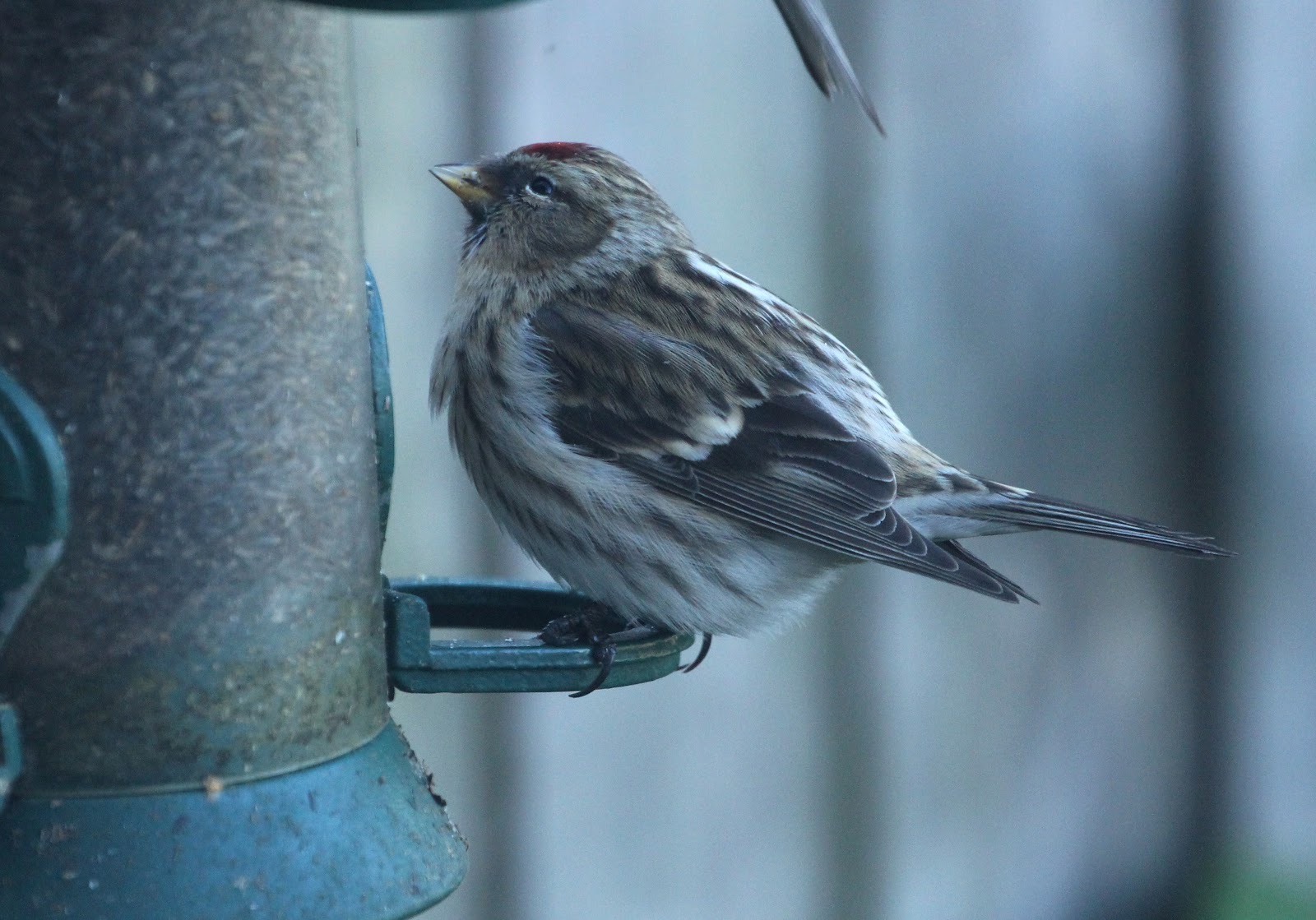
Over the past three winters, I have been nurturing an ever increasing flock of Redpolls, focused around a couple of nyger seed feeders. They twitter away all day long outside the window. At peak, 35-40 are around at once. As usual, there is an interesting array of plumage variation. Most, of course, are Lesser Redpolls, but if you take the following to be characteristics of Mealy Redpoll: grey-brown upperparts, greyer head with whitish nape collar and ‘bulging’ neck, strong white wingbars, a pale streaked rump on a white background which bleeds white into the surrounding flanks and lower back, whitish underparts and undertail coverts (some with arrow-shaped dark centres) and a long primary projection, then I have a few that fit the bill.

Unfortunately, my garden is rather dull. Redpolls are by far the commonest bird. However, if I lean out of the upstairs window on one leg and view sideways between two distant houses, I can see a sliver of the village pond. Recently, I noticed an Egyptian Goose on the pond as I drove home. A skid onto the drive and a quick run upstairs, followed by nearly one hour on one leg peering sideways and it swam across the sliver of view. Result. The problem is that the occupants of one of the above mentioned houses has an increasingly large Yucca tree growing in the crucial gap and the sliver of view is declining year on year. A midnight raid with a bowsaw has been considered, but the more obvious answer is to move. So sadly, we are leaving our glorious view over Epping Forest in the Land of Spray tan and Bling and heading to pastures new. With this momentous decision made, I got another new garden bird: a Heron came and ate all my frogs.




Thursday, 9 February 2012

Shufflers in freezing feeding frenzy

Feeding frenzy - Shufflers, Coot-muggers and a Great Crested Degree.

With a few inches of snow and an easterly breeze, I decided it was time to give Siri a go on my up-graded iPhone rather than get frozen fingers scribbling in the notebook. As I wandered around the valley, a summary of each site was carefully dictated before I headed home, hoping to find my day list magically appearing on my computer via iCloud. And there it was. Holyfield Marsh was particularly good. Apparently I saw a lot of Shufflers, 157 apparently. And also 13 Descenders, 350 Tufted Darks, 4 Snooze (3 drunks and a redhead), 15 Great Crested Degrees and a Yellow-laked Goal. I’m not sure whether I need to train Siri better or change my accent.

With large numbers of birds restricted to small areas of unfrozen water, the apparent heightened and frenzied feeding activity was interesting. Several groups of diving Coots not only had their associated kleptoparasitic Gadwalls (the ‘Coot-mugger’) but had attracted a range of other ducks and gulls. Nearby, a swirling mass of 60+ Shovelers, sorry Shufflers, continued to stir up and sift planktonic invertebrates from a small patch of water. Such feeding behaviour is typical of the Shoveler, but I can’t recall such a large group or such frenzied activity.

I had followed almost the same route around the lake back in the freezing conditions of January 1985. On that visit, the count of Smew reached a remarkable 40 birds (with at least 19 drunks), along with a Slavonian Grebe and 300 Wigeon. A Bean Goose (‘rossicus’ say my notes) had joined the adjacent Canada Goose flock but it eventually and illogically got dismissed as an escape. I think even Siri would have got that right.

Wednesday, 1 February 2012

Wild bird cover


Another trip down to Wallasea at the weekend was enlivened by a spell of watching over the area sown with ‘wild bird cover crops’, which has been attracting large numbers of birds. The influx of Short-eared owls and other raptors this winter has brought into focus, at least for me, the value of these areas for farmland birds.

At Wallasea, 15 ha has been sown with wild bird cover crops, split between spring sown, autumn sown and fallow plots, which are rotated. The spring mix, re-sown annually, contains 30% barley, 25% spring wheat, 20% millet, 20% triticale (a hybrid of wheat and rye) and 5% mustard. This plot was targeted at Corn Buntings and this winter has attracted over 300, as well as 120+ Linnet, 150 Skylark and 70 Reed Buntings. Raptors regularly seen around the plot have included up to 5 Hen Harriers, 5 Short-eared owls, Merlin, Peregrine, Sparrowhawk and Kestrel.

My recent trip to Exminster Marshes revealed another good area, with 600+ Linnets (now up to 900 apparently) and a variety of buntings on show. Last winter, during the severe weather, this plot attracted 1200 Skylarks, 800 Bramblings and 500 Chaffinches; not a bad haul.

At Greys Farm in north Hertfordshire, extensive areas of wild bird cover have benefited farmland birds, principally in a very successful effort to boost partridge populations, albeit with very intensive predator control. This winter, the farm has provided a focus for raptor watching, with three Hen Harriers, Red Kites, several Short-eared Owls and a Great Grey Shrike.

Sunday, 22 January 2012

Fancy a bit of rough?


Field Vole, SEO pellet, Bank (left) and Field Vole skulls, showing the diagnostic extra loop on the upper middle molar of the Field Vole.

This winter’s influx of Short-eared Owls, Hen Harriers and Rough-legged Buzzards has been one of the highlights of the season. Many have settled in areas of un-grazed, rough grassland, a habitat that often seems to be quickly dismissed by conservationists as having little value. It is often botanically poor (especially if it’s of recent origin) and the list of ‘what to do with it?’ usually starts with grazing or mowing.  Rough grasslands can support good populations of small mammals, such as voles, a major part of the diet of these species. Voles and some other small mammals typically show cyclical patterns of abundance. After a crash in the small mammal populations in the northern breeding areas of these birds, they move south and west and settle to winter where suitable food is available.

The diet of Short-eared Owls has been shown to consist of 95% of small mammals over numerous studies. In Britain, Field Voles account for about 85% of the diet. When voles are scarce however, SEOs will take an increased proportion of birds. In the early 1980s when SEOs regularly wintered in the Lee Valley, remains of birds were numerous in the pellets, forming a third or more of prey items. The owls seemed to be specialising on thrushes, Skylarks, finches and buntings. A pellet from one newly arrived owl at Nazeing contained the leg of a Blackbird that had been ringed previously on the Essex coast. Half a dozen pellets picked up from Heartwood Forest this weekend revealed remains of 9 Field Voles and a single Bank Vole. Rough-legged Buzzards also specialise in small mammals, notably voles and lemmings, although wintering UK birds are noted as favouring Rabbits.

Field Voles favour rough grassland with a dense thatch in which to burrow. In new grasslands they reach reasonable densities by the second year of establishment. Some research has shown that SEO hunting periods over rough grassland are positively related to vole densities until the grassland becomes densely thatched. At this stage (greater than 80% dense thatch), the relationship switches to negative; there are just as many, if not more voles, but the density of the vegetation makes them less vulnerable to predation by the owls. However, there is some suggestion that light grazing or limited cutting of older grassland may benefit the voles in that it promotes more vigorous growth of fresh, palatable grass. Such practices are just as likely to benefit the owls. So rotational strip mowing in old, tussocky grassland (perhaps a 4-6 year rotation) may benefit voles by producing fresh growth and owls by making the voles more available.

Below - Rough-legged Buzzard

Friday, 13 January 2012

Hard work


A couple of days working down in the south-west looking at ongoing projects was a bit of a strain. At Radipole Lake, the reedbed is in the best condition it’s been in for years after a considerable amount of restoration work. The chance of a booming Bittern this coming spring is as high as it has ever been. It would have been rude of course not to pop in to the visitor centre, where a quick check through the assembled mass of 300+ Med Gulls revealed 2 Ring-billed Gulls. Onward then to Exeter for an afternoon meeting at Goosemoor, a small area of land next to Bowling Green Marsh at Topsham and the site of the first Regulated Tidal Exchange in the UK. Regulated Tidal Exchange is a technique for creating and managing intertidal habitats. It uses regulated quantities of tidal water to manage the inundation regime and is often employed behind maintained sea defences. The technique has been particularly well developed in the eastern USA where impounded coastal wetlands, often in close proximity to built development, have benefited from the re-introduction of tidal flushing. The project at Goosemoor, implemented in 2004, has created a range of saline and brackish habitats (0.75 ha saline lagoon, 0.75 ha of mudflat and 4.25 ha of saltmarsh) for the benefit of breeding and wintering waterbirds. It would have been rude not to pop in to Bowling Green Marsh, just in time for the Red-breasted Goose to fly over our heads and land in front of us. At nearby Exminster Marshes, we looked at the successful use of wild bird cover crops (more of this at a later date), and were forced to endure some extremely close views of the long-staying Glossy Ibis as it wandered around us.

The following dawn saw us on Ham Wall, Somerset as a rough half-million Starlings left their roost and cruised over in one sky-wide, minute-long, wing-whirring flock. Two Great White Egrets joined a feeding frenzy of 20+ Little Egrets, half a dozen Grey Herons and a Bittern. Five Bewick’s Swans bugled nearby and an Otter spooked a flock of Tufted Duck. A quick crash around the reedbed to look at the conversion of reed into compost and briquettes was briefly interrupted by a flyover Water Pipit. And finally a quick look at the Somerset Levels was enlivened by the bunch of re-introduced Cranes with their hang-along wild mate (right-hand end, below). Work is a real chore.

Photo by John Crispin

Tuesday, 10 January 2012

Red sauce, Brown sauce, Bean Geese


Top - Taiga Beans and others.  Middle - Wigeon making the habitat unsuitable for Taiga's. Bottom - Pinks (at least they were close).

Northern people are supposed to prefer brown sauce while southerners go for the red stuff. Not for the first time, I pondered this piece of mythology the other day whilst waiting for the Taiga Bean Geese to become rather more than distant dots on the far side of Buckenham Marshes and for their little mate, the Lesser White-fronted Goose to appear. What prompted this deep, re-sauceful thinking you may ask? Well the Taiga’s are feeding predominantly on Buckenham rather than Cantley this winter.

Only two locations regularly support populations of wintering Taiga Bean Geese in the UK: Buckenham and Cantley Marshes in the Yare Valley, Norfolk, and the Slamannen Plateau in Scotland. Ringing results have suggested that the two populations breed in different parts of Scandinavia. The majority of the individuals visiting central Scotland probably belong to a fully wild sub-population, which is distinct from the one wintering in Norfolk. Part of the central Scotland flock may also derive from a re-introduction project, which started in 1974 in central Sweden. The Scottish birds tend to arrive in October. By contrast, the Norfolk birds appear to leave their breeding area in Sweden for a wintering/staging area in Denmark, before a proportion move on to the Yare Valley around the end of the year.

Now to the brown sauce, red sauce conundrum. Taiga Bean Geese have been using Buckenham and Cantley Marshes since the 1930s with numbers peaking at 1,000 birds in the 1936-37 winter. Research has indicated that the Yare Valley Taiga’s prefer to graze on unimproved pasture, feeding particularly on meadow-grasses (Poa spp). It is suggested that the large body size of the Taiga (and their disproportionately large guts) allows a more effective digestion of taller, poorer quality food than their smaller-bodied competitors. A shift from preferring Buckenham to Cantley during the 1970s was associated with a shorter sward on Buckenham resulting from increased grazing by Wigeon and sheep. As a result a proportion of the fields at Cantley are maintained to this day at a longer autumn sward height especially for the Taiga’s. By contrast, research on the Slamannen birds has shown that they feed on ‘improved’ grass fields and particularly on Rye Grass (which is apparently less digestible for the Yare Taiga’s). So how comes two populations of birds of the same species, breeding in the same country, can be so different in their digestive traits?

Hmmm confusing. Now, there is a clue to all this in the name – ‘bean’. So called, because on the continent they traditionally feed on arable farmland in the autumn, firstly on stubbles, then on waste root crops, with a shift to cereals and grasses late in the winter. Perhaps at the end of the day the research should be seen as just a ‘snapshot’ of what is happening. Grass-feeding waterfowl will specialise on the most energetically efficient area of food determined by their body characteristics. And a number of factors will also affect where the birds choose to feed, not least disturbance, to which Taiga’s are apparently sensitive. The Bean Geese will choose to feed on what is most nutritious and available in their traditional wintering areas given the conditions that prevail. But quite clearly you can’t have brown sauce on a burger ....and red sauce on bacon is a complete no-no wherever you come from. Arrh, there’s the Lesser White-front.

Sunday, 1 January 2012

Lee Valley doldrums


A total of 90 species seen throughout the valley in a thrash from bottom to top failed to disguise the dullness of the current situation. Highlights? Not really, just 2 drake Smew, 3 scattered Red-crested Pochards and a Med Gull. Wildfowl numbers are generally very low, with the exception of Gadwall. This winter has produced some high numbers, with the November peak of 500+ on Holyfield now dispersing to other sites. A couple of Ruddy Duck survive. About 30 Goosander are around, mainly in the favoured Turnford Marsh/Holyfield/Nazeing zone.

Just 3 or 4 Bittern are wintering at 3 sites (but I failed to find any of them). By contrast 30+ Little Egrets are arriving at the 2 roosts at either end of the valley. No Jack Snipe seen today, but these days all the places they are likely to be found are out of bounds.

On the passerine front, winter thrushes were the most numerous birds today, with 500+ each of Redwings and Fieldfares. They seemed to be everywhere. There also seems to have been a recent arrival of Chiffchaffs. I saw three today but up to ten may be at Rye Meads; 7 were ringed yesterday. But where are the finches? Linnet was a noticeable miss today but there seems to be no weedy areas left.

Holyfield/Cheshunt area: 2 drake Red-crested Pochard, drake Pintail, Little Owl, 500+ Redwing.

Girling: 18 Black-necked Grebes, adult Med Gull, 13 Goosander.

Walthamstow Res: 6 Ring-necked Parakeets, 4 Shelduck.

Rye Meads: 3 Chiffchaff, Cetti’s Warbler, 2 Shelduck.

Amwell: drake Smew, Red-crested Pochard, Yellow-legged Gull, 2 Lesser Redpoll.