Saturday, 22 September 2012

Black-head squeeze continues


The remarkable increase of breeding Black-headed Gulls in the Lee Valley has continued this year, nearly all of them nesting on rafts provided for Common Terns.  This year’s total amounted to 107 pairs spread across four sites, with good numbers of young birds fledged.   By contrast, the Common Terns have had a very poor year.  The total of 52 pairs is the lowest in the valley for some 30 years.  Not only that, but productivity has been equally poor.  But are these two stories linked?


Terns in general appear to have had a very mixed year, both between and within species.  The poor summer, with a high proportion of windy days preventing fishing and the downpours chilling eggs and chicks, has been a major problem.  In the valley, many terns failed to settle until very late this year, with limited success.  In general, productivity at inland colonies is frequently better than the average.  Common Terns nesting on freshwater sites have been shown to make shorter feeding forays than coastal birds, allowing for better colony protection as birds are away from the nest less. 


Although the Black-headed Gull is over ten times as numerous as the Common Tern as a breeding bird, both species have shown an interesting similarity in trend in distribution and abundance in recent decades.  Although there have been declines in the north and west of the UK, increases have taken place in inland areas of southern England, much linked to the spread of flooded gravel pits in river valleys.  In recent years, Black-headed Gulls have spread rapidly along the Thames valleys and its tributaries, in many cases nesting on rafts provided for Common Terns.  The reasons for the declines in the north are unclear but an increase in predation, particularly by Mink, and unfavourable land-use changes have been suggested as the cause.  


With the Black-heads increasing rapidly in recent years, the general feeling is that the terns are being squeezed out.  Despite this, all the local colonies had available space on the rafts.  In recent years, the delaying of the positioning of rafts has shown some limited benefits for the later nesting terns.  Perhaps the time has come to vary the design of the standard tern raft to better accommodate both species as they seem to have subtle differences in nest location.  Around the world you can find examples of a very different approach.  Look at the 22,000 m2 floating island designed for Caspian Terns in Oregon, USA for example (below).  Some trials next summer at a number of sites may begin to show the way.
 

Sunday, 9 September 2012

Rush conundrum


Phew!  A twitchable Baillon’s arrives at Rainham Marsh in a perfect viewing position.  Not unexpected, given the influx this summer (but I would guess this may be a Dutch bred bird). However, a relief after the necessary news blackout of territorial birds. At least the North London birding press should be able to report this one correctly without relying on various blogs and adding a dollop of speculation.  Journalists, pah!


I joined the assembled crowds at dawn on Saturday and marvelled at the ability of the little critter to find this particular little patch of suitable rushy habitat.  Having received some photos of Baillon’s Crake habitat in The Netherlands back in June, I noted the swamps of Flowering Rush and Bur-reed and initially thought they had sent me a picture of Rainham as a joke.  A quick e-mail to Rainham ensured they were crake surveying at night but to no avail.  Anyway, this shortish, open-structured wet vegetation appears to be just what they like.  Okay, I saw the ‘89 Sunderland bird but that clearly had a dodgy radar.


Now the conundrum.  The marvellously crakey rush habitat at Rainham does not favour the usual fare of waders and gulls.  In fact, management is being undertaken to significantly reduce the amount of rushy edges to the pools in favour of muddy margins suitable for White-tailed Plovers and the like.  Okay, the rushy habitat could be shunted away into a corner away from prime hide viewing, but then who would see the next crake?  A conundrum to be pondered and not to be rushed.  What would you do?
 
Above - Flowering Rush and botanists closely studying it.  Below - Baillon's Crake habitat in The Netherlands (Ruud van Beusekom) and at Rainham, snap!
 

Wednesday, 29 August 2012

House of reed


Blundering around inside a reedbed is all in a normal day’s work for a Grumpy Ecologist, usually ending up thoroughly wet and ‘bloodied’ with reed-cuts.  The subtle variations of reed height and density, and the water depth, provide a guide to the location of the reedy constructions of some of the reedbed inhabitants.


Water Voles can be extremely common in wet reedbeds, with latrines and feeding stations every couple of metres.  One of the less frequently mentioned signs of Water Voles is the ‘Vole Mansion’ (above photo) but deep inside reedbeds these constructions can be very numerous.  The neat ball of woven reed strips is slung within a reed framework and under a loose reedy roof, the supporting reeds trimmed off with a typical Water Vole bite.  They are often provided with a reed ramp access down to an outside latrine.  The whole mansion is around 25 cm high and 20 cm in width.


The Water Rail nest is a neat cup, about 15 cm across, of woven reed.  Built just above water level, this one was in 35 cm of water depth and typically built just above water level.  Most Water Rail nests seem to have a covering reed ‘canopy’; this one (below) is open, however it was located in tall (240 cm) and dense reed (360 stems/m2).
 
Most Bittern nests also seem to be built just above water level with good, stout, reed stems bent over and folded in, before a woven platform around 40 cm in diameter is constructed on top.  A lining of finer material, other aquatic plants if present nearby, may be added.  One or two reed ramps lead down to the water.  The deepest water I have found a Bittern nest in is 115 cm.  The nest shown below is perched at an unusually high 110 cm on its scaffolding, above 62 cm of water, but remained above this spring’s rising water levels.  A scattering of downy feathers in and around the nest provides some pointers to the successful outcome.  She obviously had heard the weather forecast. 


Saturday, 11 August 2012

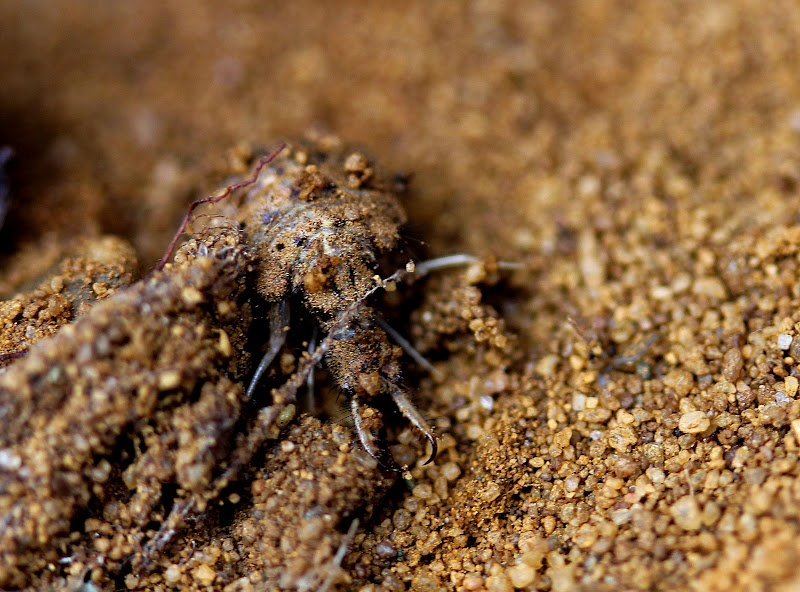
Antlion antics

Antlion larva

With perfect timing some good weather at last arrived as we embarked on an assessment of invertebrate habitat at Minsmere this week.  Overall, there is a good diversity of habitat on this section of the Suffolk coast but the increasing numbers of Red Deer and the impact of their trampling and browsing is a concern in some areas. The trip turned into a bit of a general bio-blitz, with a good range of local specialities logged over a couple of days.


Antlions are one of those local specialities, with their characteristic larval pits even being found around the visitor centre walls.  We concentrated our search down at North Warren where a concentration of 1000+ pits had been counted earlier in the season.  Many had been washed away by recent heavy rain but a good number remained. The sand at the bottom of the pits conceals a ‘Doctor Who’ monster of a larva.  As soon as a couple of ants were ‘persuaded’ to wander around the pit edge, a deadly flick of sand knocked them down to the waiting jaws.

Plenty of Grayling and Silver-studded Blue butterflies were on the wing across the heathland, a long list of bees was steadily accumulated, and each gorse bush seemed to be home a few of the widespread Labyrinth Spider Agelena labyrinthica; their large sheet webs with a tubular retreat being very obvious.  Natterjack Toads have had a good year with thousands of tadpoles being seen earlier in the year despite the ponds being rather churned up by deer.  More by luck than skill we came across a toad posing nicely within a hollow.  Nearby we found the large Robber-fly Eutolmus rufibarbis.  This splendid beast is a scarce species of southern heathlands, especially Breckland.  It lays its eggs in slits in plant stems, with the emerging larvae entering the soil and predating dung beetle larvae.  A number of scarce plants were encountered, Red-tipped Cudweed, the diminuative Smooth Cat’s-ear, Mossy Stonecrop and two species of Catchfly: Sand and Small-flowered.  Both had just finished flowering but were still readily identifiable from the developing seed capsules.

We tried not to look for birds but managed to see a few Stone Curlews and it would have been rude not to watch the group of four Spoonbills that circled, landed and fed in front of us.  These were no doubt some of the 12 or more Spoonbills currently loafing on the Suffolk coast and includes a 2011 German-ringed nestling which spent last winter on the Essex coast.  Stone Curlews have had a moderate year.  Five chicks have so far fledged from the ten pairs in the Minsmere area.  These birds generally choose undisturbed areas well away from public access but this year one pair settled close to the visitor centre, with volunteers posted at a suitable vantage point to point them out to visitors.   


Sunday, 5 August 2012

A tale of simple fisherfolk


Little Egrets have come a long way since I first twitched one at Walthamstow Reservoirs in 1972.   Locally, the first breeding of Little Egrets in the Lee Valley occurred in 2006 when a pair reared 4 young amongst the Grey Herons at Walthamstow Reservoirs.  The valley total for this year seems to be at least 26 pairs in three colonies, at Walthamstow, Amwell and Netherhall.  All are tucked rather unobtrusively into Grey Heron colonies but at least 20 broods have been seen to fledge.   Further afield, the UK breeding population is now getting close to 1,000 pairs at around 100 colonies.  One of the largest colonies is at Northward Hill in north Kent where numbers grew to a peak of 124 breeding pairs in 2009, equalling and then exceeding the numbers of Grey Heron, before dropping to 114 in 2010 and then 94 pairs in 2011 as a result of two successive cold winters.  So this mainly fish-eating bird is on the rise.


By contrast, breeding Cormorants peaked in the Lee Valley a few years back at a little under 400 pairs.  Since then total numbers have dropped despite an increase in the number of colonies.   This year the number of active nests in the Valley was around 250 and reflects a steady decline locally over recent years. 


Which brings us neatly to the recent call by angling groups to add Cormorant to the general licence, thus easing the restrictions on killing.  Now, I spent a lot of time ‘angling’, well electro-fishing to be accurate, and then I’m only the assistant, brought along to get wet and carry the boat.  In attempting to create new wetlands, much time is  and effort is spent enhancing the underwater ‘fish’ habitat.  Fish populations reaching a critical threshold is one of the trigger points for getting birds such as the Bittern to breed.   Many reserves support good fish populations and the key issue is habitat quality, notably underwater landform, structure and connectivity, the water quality and the diversity of aquatic vegetation.   Cormorants have never been implicated as a problem on reserves except in an isolated case where an isolated pool was over-stocked to try and create a specific feeding area for birds.  And there perhaps we hit the main issue.  Not only do angling clubs frequently stock way above natural densities but they often tend to have sites with poor habitat quality. Redundant gravel pits for example, which even if earmarked as an angling lake, have little or no attention paid to the underwater habitat in the restoration process.  So the recent outburst against Cormorants smells rather fishy.  Rather than a serious attempt to address the real problems this looks like another attempt to solve a perceived issue with a gun.   

Conservationists and anglers should be on the same side.  Wouldn’t it be great to develop partnerships on some sites where we both work to improve fish stocks through good habitat management?

Tuesday, 31 July 2012

Crakey! Change the record books.

Calling Baillon's in typically rushy habitat.

Last year, during a trip to The Netherlands, we speculated that Baillon’s Crake was being overlooked in the UK, both as a migrant and breeding bird.  With fortuitous timing, a national Spotted Crake survey has been undertaken this year and surveyors were asked to listen out for Baillon’s Crake.  And one was found!  A rapid e-mail to reserve managers to raise awareness of the possibility of Baillon’s resulted in at least 7 singing males at 3 sites across England and Wales, with a possible 2 more at 2 further sites.  Crakey!


So is Baillon’s Crake a scarce migrant and rare breeder in the UK rather than a vagrant?  Probably, but it is likely that the drought conditions in the Donana region of Spain earlier this year will have prompted more birds to move north looking for favourable conditions.  The drought appears to have affected a range of species.  We have seen influxes of Glossy Ibis and Black-winged Stilts, as well as Baillon's Crakes, and impacts on the movements of other birds, such as Spoonbills.   At least 3 pairs of stilts have attempted to breed in the UK as predicted in an earlier blog.   The Netherlands is also having a good year for Baillon's Crakes with at least 30 singing males.   However, 2005 was also good in The Netherlands yet failed to produce a record in the UK.   Were they overlooked?

Baillon’s Crakes can breed in small areas of suitable habitat; wet, low, tussocky but often open vegetation such as flooded sedges, rushes and grasses.  They also seem to like the edges of pools if this year’s birds are anything to go on.  Calls are poorly understood.  Although the best known is the short Garganey-like rattle of the male, at least 4 different calls have been heard from birds this year.  However, calls can be hard to hear in many conditions and they may not call that often!   Singing birds appear to be best heard between 22.30 and midnight at least, and with birds in The Netherlands known to arrive late, they may be singing well into July.   How many of this year’s birds will return next year?
 
 
Typical Baillon's habitat in The Netherlands (Ruud van Beusekom)


Sunday, 15 July 2012

Beaver!


If there’s anything likely to make the Grumpy Ecologist un-grumpy it’s the Beaver.  The Beaver highlight of a three-day trip to north-east Scotland began by creeping knee-deep in water through a remote section of a nature reserve on a gloomy evening, with steady drizzle of course.  A Spotted Crake briefly whipped from a fantastically crakey marsh, a Marsh Harrier flew by, and then there it was: an initially unrecognised turd deposited in a super-highway of a path out of the water. Suddenly we were at Beaver-central; fallen trees, dragged branches, pathways and a possible lodge.  Fantastic!

The day had begun at the Loch of Strathbeg; at the UK’s largest dune loch.  A brief search along the Loch shore for Creeping Spearwort (or its hybrid with Lesser Spearwort) always looked likely to fail due to unseasonably high water levels but a summer plumaged Slavonian Grebe, 35 Goldeneye and a flyby Bonxie kept us happy. The rushy Low Ground in front of the visitor centre, now grazed by a herd of Koniks held a couple of hundred Curlew and a summering pair of Whooper Swan, while botanical interest was provided by Lesser Butterfly Orchid and the remarkably insignificant, but scarce, Mudwort.  After some hours looking at the management of the reserve, the drive south took us past the disgraceful Trump’s Folly and down to Blackdog for the scoter and Eider flocks harbouring Black Scoter and Surf Scoter. All paled into insignificance compared with the soon-to-be new addition to my British wildlife poo collection (the first since Wallaby on the IOM).

Now if any extinct animal should be returned to the UK, it is the Beaver (and then the Lynx).  However, potential introductions have become bogged down in ridiculous controversy and ‘fence-sitting’. Meanwhile, Beavers have done it for themselves, escaping from captivity on the River Tay and spreading out over recent years.  Why is the Beaver so important? Well, the Beaver is an ‘ecosystem engineer’; one of the few species that can significantly change the geomorphology and hydrology of the landscape.  In doing so, Beavers have been shown to increase habitat and species diversity at the landscape scale.  By the beginning of the 20th century, hunting had reduced the European populations of Beaver to a low ebb of some 1,000 individuals.  Then, as recognition of its qualities grew, re-introductions progressed across Europe, beginning in Sweden as long ago as 1922.  Over the last 80 years, Beavers have been reintroduced to 27 countries on mainland Europe, with the UK being one of the few exceptions. Despite this, Scottish Natural Heritage embarrassingly tried to remove the Tay freedom fighters.  More can be found out about the Tay Beavers here Let’s hope they are here to stay.

At Loch of Strathbeg: Koniks, Whooper and Mudwort.