Tuesday, 9 October 2012

Scilly 1979 – a blast from the past


As usual, we cruised across to the islands on the Scillonian, a reasonably smooth crossing for once, dumped the bags and then tried to find out the latest bird news by the usual methods – the blackboards and semaphore. We quickly joined a stream of birders heading towards Higher Moors where a Subalpine Warbler was on show. Around 250 birders funnelled down a narrow muddy track, jostling and pushing to see the bird, tempers flared, some chap ended up in the ditch on his backside.   A great start.  A Rustic Bunting provided the next stop towards the north of the island and the rest of the day was made up with standard Scilly ‘fillers’ of the time: 2 Short-toed Larks, Pink Stink and a Tawny Pipit.  The following day a quick trot saw us down on Lower Moors looking for a Sibe Stonechat.  Viewing was tricky with the old ‘brass and glass’ scope, I wish they would hurry up and invent the tripod.


Excitement! a putative Blyth’s Reed Warbler had been found on St Agnes.  Unfortunately it was in a small private field.   Queuing for the 300 birders boating over to Aggy was the order of the day, with ten birders in the field for 15 minutes, tough if you don’t see it.  All progressed relatively well and in good humour as the bird performed well.  However, gentle mumbling increased to severe doubt and eventually the Guru of the day, Pete Grant, declared it was just a Marsh Warbler.  Trouble was, nobody knew what a Blyth’s Reed looked like.  My book gave some guidance; Brownish. Difficult to distinguish. See Marsh Warbler.  I checked Marsh Warbler; Brownish. Difficult to distinguish. See Blyth’s Reed Warbler.  Hmmm, crystal.


Stress set in over the next couple of days as we were led a merry dance by a Rose-breasted Grosbeak that would appear in front of birders, then vanish, then appear again in another part of the island.  The grapevine was not quick enough for this sort of thing.  We moped around in obvious places waiting for news and while checking around the airfield, where a Cory’s Shearwater off Giant’s Castle was an unexpected bonus, my eye was attracted to a vibrant orange thing up on Porth Hellick down.  A quick look through bins revealed a birder with striking orange hair jumping up and down waving madly (a standard communication method of the day).  He had the Grosser!  We legged it up there and enjoyed our first tick of the week. Stress subsided, a good bird at last.   ‘Beacon bonce’, as the orange-haired one became known, was our hero. 


A routine check of Aggy again turned up trumps as a Radde’s Warbler was discovered in a garden off the main road as we were passing.  Another tight squeeze ensued as there were few available gaps in the hedge.  An amused local provided some step ladders for personal, if somewhat wobbly, additional viewing.  This was quickly followed back on Mary’s by a proper dash up towards the golf course for a Swainson’s Thrush, another tick!  A trip over to Tesco’s added the regular Black Duck, a Ring-necked Duck and the usual Bob-white Quail.


The week ended quietly with the usual fodder of a Lesser Golden Plover (or American GP as you call them now), Spotted Crake, Little Bunting, another Rustic Bunting, R-b Fly, Yellow-broweds, a couple of Dickie Pips  and the obligatory ‘small dark wheatear’ – yes, it rained one day.  But a 2-tick week was not to be scoffed at and we departed happily enough.

Pics.  Top:  Grosser!, Above: team member Tim Andrews finds a Yellow-browed (note all the 'brass and glass').  Below: Radde's on Aggy, my turn for the steps! (whats that new-fangled metal thing with 3 legs?, Bottom: the best dressed birders today have Swift Audobons and a handbag (Beacon bonce takes a nap).

Friday, 5 October 2012

Scilly enough?


The bloke who used to run the disco on the quay with an Aladdin Sane style painted face was looking past his best. He probably thought the same of me. "You still do the disco on the quay" I enquired. "Blimey, you've been coming here a long while" he replied. But let's hope he now has more than 5 records in his collection, I like Siouxsie and the Banshees but not every 15 minutes.  After visiting the Isles of Scilly every year from 1975 until 1995, we had not been back for 17 years. This was the 'old gits return' tour, one last hurrah. First impressions were that not much had changed other than there were virtually no birders, a few more posh houses had appeared and everything was a lot more expensive. We set out to find birds.

The Aquatic Warbler was typically ground hugging and elusive as it grovelled amongst the iris by Porthloo Pond. A couple of flight views was the best on offer. By contrast, the Ortolan was best mate with the sparrows on Porthcressa beach and behaved in a similarly approachable fashion. A couple of Yellow-browed 'sweeeet'ed and showed briefly in Lower Moors and a Lapland Bunting rattled and rolled over the golf course. Just as I remembered it. Peninnis never seemed that far in the past but it felt like a long slog this time. A scattering of pipits including the Buff-bellied lurked around the lighthouse but the old lookout pole seemed to have gone. I was looking forward to climbing that again.


The fact was, everywhere seemed further than it was before. Did we really walk twice around St Mary's everyday? Anyway, no problem, now they have introduced electric carts for the old gits.  However, there are significant changes; the birders are not only far fewer in number but on average much older and probably only a handful with much experience. Fewer birders out there, fewer birds being found. On one day, we were the only birders on the boat over to Tesco's. Scilly has become like an extended episode of Dad's Army; all the old dodderers holding forth whilst the young guns are away at new frontlines.


Captain Mainwaring is everywhere, pompously standing guard with his radio/CB and spouting. "Don't stand there you stupid boy, I've been coming to Scilly for 6 years now".  Privates Fraser and Godfrey were dipping down at the shy Aquatic. "We are doomed" said Fraser, "there are more birds on Shetland". Godfrey shuffled up, "I had to be excused, but my sister Dolly says there are two Buff-breasts on the airfield now". "No you old duffer" says the Verger "one's a Dotterel". Meanwhile, Private Walker was down the Scillonian Club selling dodgy videos of the glory days.
Corporal Jones came charging up "Don't panic, don't panic. I've looked at the Snipe at Porth Hellick. They're all Wilson's". And so it went on.


We eventually added Pink Stink, R-b Fly, Barred and Bonelli's, with Yellow-broweds everywhere. No modern day mega's, but still a lovely place, and once upon a time that might have seemed like a reasonable haul.


Below: Ortolan, Buff-breast, Dotterel, R-b Fly and old gits twitch-cart.


Saturday, 22 September 2012

Black-head squeeze continues


The remarkable increase of breeding Black-headed Gulls in the Lee Valley has continued this year, nearly all of them nesting on rafts provided for Common Terns.  This year’s total amounted to 107 pairs spread across four sites, with good numbers of young birds fledged.   By contrast, the Common Terns have had a very poor year.  The total of 52 pairs is the lowest in the valley for some 30 years.  Not only that, but productivity has been equally poor.  But are these two stories linked?


Terns in general appear to have had a very mixed year, both between and within species.  The poor summer, with a high proportion of windy days preventing fishing and the downpours chilling eggs and chicks, has been a major problem.  In the valley, many terns failed to settle until very late this year, with limited success.  In general, productivity at inland colonies is frequently better than the average.  Common Terns nesting on freshwater sites have been shown to make shorter feeding forays than coastal birds, allowing for better colony protection as birds are away from the nest less. 


Although the Black-headed Gull is over ten times as numerous as the Common Tern as a breeding bird, both species have shown an interesting similarity in trend in distribution and abundance in recent decades.  Although there have been declines in the north and west of the UK, increases have taken place in inland areas of southern England, much linked to the spread of flooded gravel pits in river valleys.  In recent years, Black-headed Gulls have spread rapidly along the Thames valleys and its tributaries, in many cases nesting on rafts provided for Common Terns.  The reasons for the declines in the north are unclear but an increase in predation, particularly by Mink, and unfavourable land-use changes have been suggested as the cause.  


With the Black-heads increasing rapidly in recent years, the general feeling is that the terns are being squeezed out.  Despite this, all the local colonies had available space on the rafts.  In recent years, the delaying of the positioning of rafts has shown some limited benefits for the later nesting terns.  Perhaps the time has come to vary the design of the standard tern raft to better accommodate both species as they seem to have subtle differences in nest location.  Around the world you can find examples of a very different approach.  Look at the 22,000 m2 floating island designed for Caspian Terns in Oregon, USA for example (below).  Some trials next summer at a number of sites may begin to show the way.
 

Sunday, 9 September 2012

Rush conundrum


Phew!  A twitchable Baillon’s arrives at Rainham Marsh in a perfect viewing position.  Not unexpected, given the influx this summer (but I would guess this may be a Dutch bred bird). However, a relief after the necessary news blackout of territorial birds. At least the North London birding press should be able to report this one correctly without relying on various blogs and adding a dollop of speculation.  Journalists, pah!


I joined the assembled crowds at dawn on Saturday and marvelled at the ability of the little critter to find this particular little patch of suitable rushy habitat.  Having received some photos of Baillon’s Crake habitat in The Netherlands back in June, I noted the swamps of Flowering Rush and Bur-reed and initially thought they had sent me a picture of Rainham as a joke.  A quick e-mail to Rainham ensured they were crake surveying at night but to no avail.  Anyway, this shortish, open-structured wet vegetation appears to be just what they like.  Okay, I saw the ‘89 Sunderland bird but that clearly had a dodgy radar.


Now the conundrum.  The marvellously crakey rush habitat at Rainham does not favour the usual fare of waders and gulls.  In fact, management is being undertaken to significantly reduce the amount of rushy edges to the pools in favour of muddy margins suitable for White-tailed Plovers and the like.  Okay, the rushy habitat could be shunted away into a corner away from prime hide viewing, but then who would see the next crake?  A conundrum to be pondered and not to be rushed.  What would you do?
 
Above - Flowering Rush and botanists closely studying it.  Below - Baillon's Crake habitat in The Netherlands (Ruud van Beusekom) and at Rainham, snap!
 

Wednesday, 29 August 2012

House of reed


Blundering around inside a reedbed is all in a normal day’s work for a Grumpy Ecologist, usually ending up thoroughly wet and ‘bloodied’ with reed-cuts.  The subtle variations of reed height and density, and the water depth, provide a guide to the location of the reedy constructions of some of the reedbed inhabitants.


Water Voles can be extremely common in wet reedbeds, with latrines and feeding stations every couple of metres.  One of the less frequently mentioned signs of Water Voles is the ‘Vole Mansion’ (above photo) but deep inside reedbeds these constructions can be very numerous.  The neat ball of woven reed strips is slung within a reed framework and under a loose reedy roof, the supporting reeds trimmed off with a typical Water Vole bite.  They are often provided with a reed ramp access down to an outside latrine.  The whole mansion is around 25 cm high and 20 cm in width.


The Water Rail nest is a neat cup, about 15 cm across, of woven reed.  Built just above water level, this one was in 35 cm of water depth and typically built just above water level.  Most Water Rail nests seem to have a covering reed ‘canopy’; this one (below) is open, however it was located in tall (240 cm) and dense reed (360 stems/m2).
 
Most Bittern nests also seem to be built just above water level with good, stout, reed stems bent over and folded in, before a woven platform around 40 cm in diameter is constructed on top.  A lining of finer material, other aquatic plants if present nearby, may be added.  One or two reed ramps lead down to the water.  The deepest water I have found a Bittern nest in is 115 cm.  The nest shown below is perched at an unusually high 110 cm on its scaffolding, above 62 cm of water, but remained above this spring’s rising water levels.  A scattering of downy feathers in and around the nest provides some pointers to the successful outcome.  She obviously had heard the weather forecast. 


Saturday, 11 August 2012

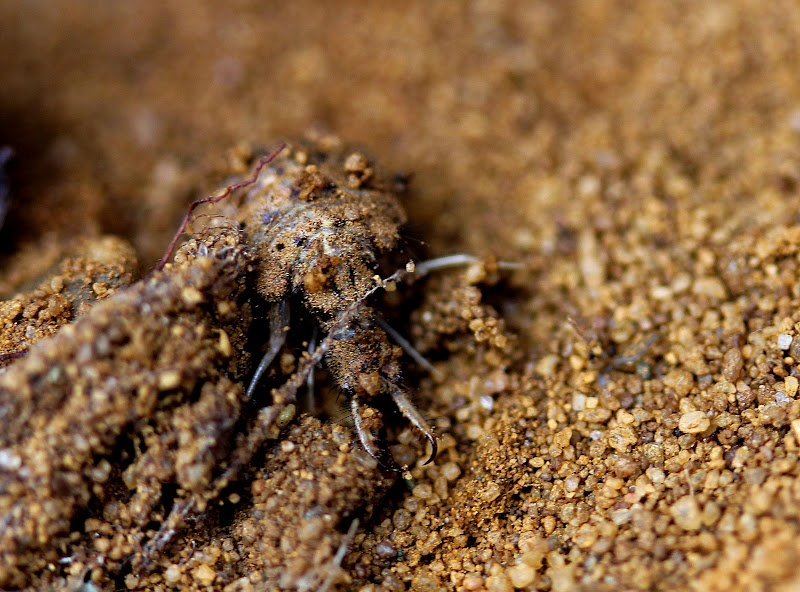
Antlion antics

Antlion larva

With perfect timing some good weather at last arrived as we embarked on an assessment of invertebrate habitat at Minsmere this week.  Overall, there is a good diversity of habitat on this section of the Suffolk coast but the increasing numbers of Red Deer and the impact of their trampling and browsing is a concern in some areas. The trip turned into a bit of a general bio-blitz, with a good range of local specialities logged over a couple of days.


Antlions are one of those local specialities, with their characteristic larval pits even being found around the visitor centre walls.  We concentrated our search down at North Warren where a concentration of 1000+ pits had been counted earlier in the season.  Many had been washed away by recent heavy rain but a good number remained. The sand at the bottom of the pits conceals a ‘Doctor Who’ monster of a larva.  As soon as a couple of ants were ‘persuaded’ to wander around the pit edge, a deadly flick of sand knocked them down to the waiting jaws.

Plenty of Grayling and Silver-studded Blue butterflies were on the wing across the heathland, a long list of bees was steadily accumulated, and each gorse bush seemed to be home a few of the widespread Labyrinth Spider Agelena labyrinthica; their large sheet webs with a tubular retreat being very obvious.  Natterjack Toads have had a good year with thousands of tadpoles being seen earlier in the year despite the ponds being rather churned up by deer.  More by luck than skill we came across a toad posing nicely within a hollow.  Nearby we found the large Robber-fly Eutolmus rufibarbis.  This splendid beast is a scarce species of southern heathlands, especially Breckland.  It lays its eggs in slits in plant stems, with the emerging larvae entering the soil and predating dung beetle larvae.  A number of scarce plants were encountered, Red-tipped Cudweed, the diminuative Smooth Cat’s-ear, Mossy Stonecrop and two species of Catchfly: Sand and Small-flowered.  Both had just finished flowering but were still readily identifiable from the developing seed capsules.

We tried not to look for birds but managed to see a few Stone Curlews and it would have been rude not to watch the group of four Spoonbills that circled, landed and fed in front of us.  These were no doubt some of the 12 or more Spoonbills currently loafing on the Suffolk coast and includes a 2011 German-ringed nestling which spent last winter on the Essex coast.  Stone Curlews have had a moderate year.  Five chicks have so far fledged from the ten pairs in the Minsmere area.  These birds generally choose undisturbed areas well away from public access but this year one pair settled close to the visitor centre, with volunteers posted at a suitable vantage point to point them out to visitors.   


Sunday, 5 August 2012

A tale of simple fisherfolk


Little Egrets have come a long way since I first twitched one at Walthamstow Reservoirs in 1972.   Locally, the first breeding of Little Egrets in the Lee Valley occurred in 2006 when a pair reared 4 young amongst the Grey Herons at Walthamstow Reservoirs.  The valley total for this year seems to be at least 26 pairs in three colonies, at Walthamstow, Amwell and Netherhall.  All are tucked rather unobtrusively into Grey Heron colonies but at least 20 broods have been seen to fledge.   Further afield, the UK breeding population is now getting close to 1,000 pairs at around 100 colonies.  One of the largest colonies is at Northward Hill in north Kent where numbers grew to a peak of 124 breeding pairs in 2009, equalling and then exceeding the numbers of Grey Heron, before dropping to 114 in 2010 and then 94 pairs in 2011 as a result of two successive cold winters.  So this mainly fish-eating bird is on the rise.


By contrast, breeding Cormorants peaked in the Lee Valley a few years back at a little under 400 pairs.  Since then total numbers have dropped despite an increase in the number of colonies.   This year the number of active nests in the Valley was around 250 and reflects a steady decline locally over recent years. 


Which brings us neatly to the recent call by angling groups to add Cormorant to the general licence, thus easing the restrictions on killing.  Now, I spent a lot of time ‘angling’, well electro-fishing to be accurate, and then I’m only the assistant, brought along to get wet and carry the boat.  In attempting to create new wetlands, much time is  and effort is spent enhancing the underwater ‘fish’ habitat.  Fish populations reaching a critical threshold is one of the trigger points for getting birds such as the Bittern to breed.   Many reserves support good fish populations and the key issue is habitat quality, notably underwater landform, structure and connectivity, the water quality and the diversity of aquatic vegetation.   Cormorants have never been implicated as a problem on reserves except in an isolated case where an isolated pool was over-stocked to try and create a specific feeding area for birds.  And there perhaps we hit the main issue.  Not only do angling clubs frequently stock way above natural densities but they often tend to have sites with poor habitat quality. Redundant gravel pits for example, which even if earmarked as an angling lake, have little or no attention paid to the underwater habitat in the restoration process.  So the recent outburst against Cormorants smells rather fishy.  Rather than a serious attempt to address the real problems this looks like another attempt to solve a perceived issue with a gun.   

Conservationists and anglers should be on the same side.  Wouldn’t it be great to develop partnerships on some sites where we both work to improve fish stocks through good habitat management?