Saturday, 29 October 2011

Island Mere in ruddy health


Rudd (top), Roach and the new Island Mere hide.  Note head shape and mouth structure of the fish.

Electro-fishing the Island Mere at Minsmere usually has to be a quick affair so as not to upset too many visitors. However, this week it was more leisurely as it is closed to visitors while a new island mere hide rises from the marsh. The hide traditionally provides excellent views of Bitterns on the edge of the mere and it was along these margins and in the adjacent ditches that we concentrated the fishing effort. The results were spectacular – an estimated fish biomass of 74 kg/ha - one of the best recorded at Minsmere. Roach formed the bulk of the biomass, but with significant increases in Rudd and Perch. Tench, 3-spined and 9-spined Sticklebacks made up the remainder of the catch.

Research has shown that Rudd are a major food source for breeding Bitterns whilst Roach are less important. Why should this be for two apparently similar fish? The answer probably has to do with differences in their behaviour. During the daylight hours of the summer months, Rudd tend to hide amongst the reedy marginal vegetation, thus making themselves easier to catch by Bitterns. By contrast, Roach spend more time out in the open water amongst weeds and away from the margins. However, in the winter months, both species move into deeper, more sheltered ditches and Roach are likely to be more available to feeding Bitterns. Given good water levels in the spring, the signs are good for breeding Bitterns next year.


Earlier in the week, on another site, I looked at the nesting site of a pair of Cranes. They can be remarkably secretive in the breeding season and tend to choose a secluded nest site surrounded by shallow water. The nest often looks out over a small clearing in the wetland where they can see the approach of predators. This particular nest clearing is growing over fast and work will be required this winter to open it up a little. However, whilst the young chicks will feed around the nest, it is the quality of the wider foraging area that will determine the likelihood and speed of the chicks fledging. Invertebrate-rich, tall vegetation, preferably in wet (squidgy) conditions is a key requirement.

Friday, 21 October 2011

Shingle session


Twite, Purple Glasswort and Sea Pea.

The coastline between Dunwich and Walberswick in Suffolk supports some excellent shingle and lagoon habitat. Yesterday was spent wandering around the Dingle Marshes thinking about some of the key issues. Sea level rise is a major threat to this stretch of coast and recent inundations have pushed the shingle back, creating some great looking habitat for Little Terns and Ringed Plovers, or it would be but for the heavy disturbance in this popular holiday area. The remains of Sea Pea and Sea Kale were evident but such specialist shingle plants are also suffering from trampling.  Almost the first bird I saw was a Glossy Ibis, flying up from one of the pools and disappearing over the ridge towards the Walberswick reedbeds. However I spent rather longer watching some more typical winter visitors – a flock of 16 Twite feeding where the shingle meets the saltmarsh.

Twite wintering on the east and south coasts of England are thought to be mainly, or entirely, from the small south Pennines breeding population. It is possible that small numbers of Twite from Norway also winter in this area, although no Norwegian-ringed birds have so far been recorded in the UK, despite the large numbers ringed in Norway. The number of Twite wintering on the east coast have declined substantially over the last few decades. Flocks of thousands were noted around The Wash back in the 70s and 80s but now the latest estimates are of no more than 450 birds between the Humber and Kent. The Dingle/Dunwich area remains the main locality in Suffolk. Wintering Twite feed on the seeds of Glasswort, Annual Sea-blite, Sea Lavender and Sea Aster, with late winter distribution shown to be strongly related to the density of remaining Glasswort seeds.

Half a dozen Spot Shanks, several Greenshank, Knot, Dunlin and Grey Plover fed around the shallow lagoons behind the beach with a number of Rock Pipits and at least one Water Pipit. Redwing, Fieldfare and Siskin calls constantly reminded of small parties passing overhead. A Red Kite drifting south completed a reasonable morning.

Monday, 3 October 2011

Passed glories


 Broadhurst Clarkson 4-draw - my first 'scope, Wood Sands on condom island, Rye Meads 1984.

With unidentified stints seemingly on every patch of mud in the country, I decided it was time to check out the Valley’s wader hot spots. Unfortunately I was 30 years too late. Remember the good old days, when you could pop down to the local sewage works? You crept up the bank and positioned yourself in a bed of nettles, 4-draw scope balanced on your legs, watching the pool of deep brown, bubbling and steaming liquid, with condom-encrusted muddy islands dotted with Green and Common Sandpipers and waiting for a Ruff or two to drop in?

The Lee Valley had a string of such sites, Rye Meads, Broxbourne, Rammey Marsh, Ponders End and Edmonton (Deephams) at least. G E Lodge ‘discovered’ the Lee Valley sewage farms as early as 1900, recording at Edmonton and Ponders End. He found the first nesting Ringed Plovers in the London area in 1901 and was recording Dunlin, Greenshank, Black-tailed Godwits and Ruffs, via his shotgun, around that time. Much later, London’s sludgy gems at Perry Oaks and Beddington were ‘discovered’, the former by Lord Hurcomb in 1946 (who once asked to look through the very scope in the picture to view a distant wader).

Rye Meads was the first sewage works that came to my attention, after the appearance of a Solitary Sandpiper in 1967. It was one of those secret places surrounded by high chain-link fences and barbed wire, where birding news only slowly crept out when everything had gone. I still find it difficult to go through the gate of that place. I’d much rather look for a hole in the fence or catch the seat of my trousers as I scramble over a weak part of the defences. Other sites in the valley were located by searching the Ordnance Survey map for the magical word ‘works’, followed by a recce to find a weak spot around the perimeter. Once in, creep up the bank through the ten foot high nettles, peer over the top and hope for sludgy goodness covered in waders. And further afield, who will forget the birding experience of watching at Wisbech when the shit lorry arrived and disgorged. It always seemed to make me feel hungry for some reason. Conveniently, there was usually a fine crop of poo passed pip tomatoes growing right in front of you.

Sadly such places are all but gone, lost to modern techniques. In theory, we could re-create such places if we all made a ‘contribution’.

Below - Rye Meads 1986, Deephams 1985. 

Saturday, 1 October 2011

Magnam swirls take shape.


Heard of Bowers Marsh yet? No? Believe me, if you are a birder, you will do before long. I was back down in south Essex yesterday to look at the continuing development of this new RSPB nature reserve. This massive habitat re-creation project aims to create a range of dynamic, salty to fresh, wet to dry, Thames-side habitats. I have previously blogged about Bowers at an earlier stage of the work. Now the diggers have done most of their work and some areas have started to ‘settle down’. Compare the top picture here with the same view below. Avocets have already moved in and bred on the new ‘creek’.

The new 20 hectare scrape will also function as a reservoir for the grazing marsh habitats; brim full in winter but releasing water through the spring and summer to keep the marsh wet. Today the contactors carefully placed a ‘topping’ of sand and gravel on the islands constructed within the scrape, but how do you explain to dozer drivers how you want the mix spread? Well, I pondered, bit the top off my ice cream (it was a warm day), looked down, and said “We need to create intimate swirls of differing substrates, from sand to chocolate, sorry, I mean gravel”. And so the Magnam swirl island was conceived.


This week, the first tides surged onto the new saline lagoon. The lagoon will eventually support a mix of mud flats, saltmarsh and islands. Tides will flow on daily to controlled levels. Gulls seem to like the new habitat; Meds and Yellow-legs mingled amongst the hundreds of Herring and Lesser Black-backs.


Wednesday, 21 September 2011

Scrapes, plums and flaming O's


Probably not the most popular person yesterday as I collected samples of invertebrates from the scrape at Minsmere.  A flurry of birds and all were gone - apart from a couple of tame Pec Sands and 'Fiona' the Flaming O.  The invertebrate samples will help inform management, providing further information on the food resource available to birds in water of differing salinities.  More on this when the results are in.  A couple of Whimbrel and a fly-by Curlew Sandpiper added interest.

Back onto the path and the scrape-side bushes were dripping with ripe plums. There seems to be a bewildering array of ‘wild plums’ to be found in our hedgerows. Fruits of differing sizes and ranging in colour from yellow and red through to purple. The plum is thought to be the result of hybridization between the Sloe Prunus spinosa and the Cherry Plum Prunus cerasifera. Such hybrids and an array of back-crosses fall under the Wild Plum Prunus domestica heading, with various forms or subspecies. These late-ripening fruits at Minsmere seem to fall into the 'Bullace' category (P. d. insititia).  In a minute or two, enough were gathered to produce a tasty Wild Plum Frangipane - just like this.

Friday, 16 September 2011

Extreme vis-migging


Lower pic - the Lee Valley from Tower 42 - Walthamstow, the Girling, the George and beyond.

I’m not keen on heights but as Tower 42 is now only the 5th tallest building in London, at 600 feet, I thought I’d give it a go. We clambered up various steps and ladders onto level 47, the very top, with a splendid all-round view of London for a session of watching for visible bird migration over the city.

Everything looks very small from up there!  No doubt, the more eyes looking the better, but in 4 hours we recorded the following: 22 Lesser Black-backed Gull, 4 Buzzards, 3 Kestrels, 4 Sparrowhawks, 2 Peregrines, 5 Cormorants, 1 House Martin, 10 Swallows, 1 green balloon, 1 blue balloon, 1 Tesco bag and 5 flies.

An excellent morning that showed the potential if you could hit the right day. Many thanks to David Lindo for organising it all (as detailed here) and to the tolerant Tower 42 security guys for putting up with us.

Tuesday, 13 September 2011

Chipirones and carrots


The top priority as we pulled into Sant Carles de la Rapita was a plate of chipirones (fried little squid) and a cold beer. A plate of razor clams drizzled with oil and lemon soon followed, oh and some octopus 'a la plancha' of course. Several hundred Swallows moved south past the front of the harbour-side bar as we swallowed. The first of many Audouin’s Gulls drifted by. Another plate of chipirones? So started our weekend seafood extravaganza in the Ebro Delta in Spain.

After a long lunch we drifted out into the delta to work up an appetite. Rice fields everywhere; the wet harvested areas full of egrets and herons. Most of the delta is now given over to rice production but there are a few protected areas of wetland (but many are privately owned by hunters) that support tens of thousands of waterbirds. The brackish La Tancada lagoons held 300+ Greater Flamingos and many passage waders; Little Stints were everywhere and Kentish Plovers dotted about.

L'Encanyissada is a large shallow freshwater lake surrounded by reedbeds. Hundreds of duck, including Red-crested Pochard, and another 200+ Flamingo formed the main birdy backdrop. At least 150 Whiskered Terns hawked back and forth along the margins or perched on every stick that stuck out of the water. Little Bitterns and Squacco Herons flew hither and thither. A flock of 8 carrot-beaked Caspian Terns arrived in front of us. As dusk drew near, Night Herons appeared miraculously all around and straggling flocks of Purple Herons rose out of the reeds. Stomachs began to rumble. We were soon into the main event; sucking the juicy brains out of Mediterranean Red Prawns, slurping more clams out of their garlicky shells and working through a huge pot of mixed fishes in fishermans sauce thickened with a garlic and almond picada. Yum. A fine Rioja eased their passage.
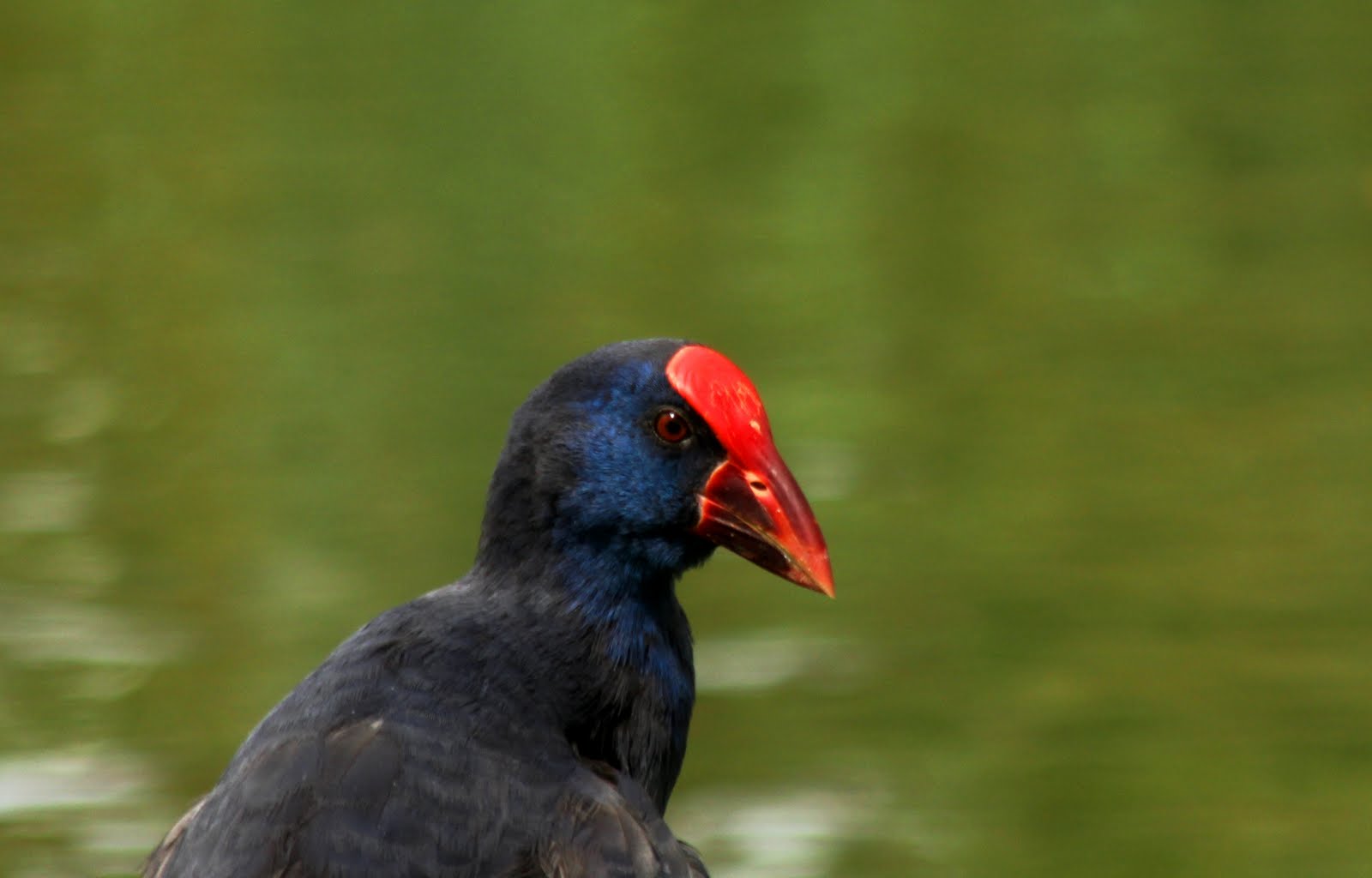
The following morning we headed out to Riet Vell, where the SEO (Spanish Ornithological Society) have a site than produces organic rice. The harvested fields were left wet and held many waders; Temminck's Stints, Wood Sands, Curlew Sands, Greenshanks and LRPs were the most numerous. A quick look from the hide overlooking the reedy lagoon resulted in an eye to beak meeting with a Purple Gallinule.

Zig-zagging through the rice fields we arrived at El Garxal lagoon. Hundreds of terns (Common, Little and Sandwich) congregated along the shoreline, along with more Whiskered and another couple of Caspian Terns and many Med Gulls. Three flocks of Glossy Ibis, totalling around 200 birds, arrived off the sea and headed inland. Fan-tailed Warblers zitted up and down and Sardinians rattled. A Praying Mantis obliging sat on my finger, wondering if I looked like dinner. Dinner did you say? We eased back to a restaurant on the edge of some marshland. Is that a Moustached Warbler in front of those Penduline Tits? Never mind, here come the langoustines with green beans and basil (steady, that's enough of the vegetables), then the clams, the smoked eel and yet more crispy yet succulent chipirones.

Swallows continued to flood south, now joined by increasing numbers of Sand Martins, as more seafood headed in the same direction, washed down with a nice chilled Cava. More Audouin’s Gulls floated by. Sea Cucumbers anyone? A great weekend, shame we didn't have more time, I didn't try the oysters.

The full list:
Squid, cuttlefish, octopus
3 species of prawn
4 species of clam, including razors and tellins
Mussels
A spikey-shelled whelky-type thing
Eels
Hake, sole, monkfish, salt-cod, anchovies, sardines, fried baby fish.