Monday, 30 April 2012

Weather for ducks


Until the recent deluge, it appeared that another dry spring was upon us and the focus of reserve visits recently has been on the efficiency of water management.  Although concerns about the effects of the drought on wetlands and wetland birds have been somewhat over-hyped, it is certainly worth thinking about how we manage our water resources, particularly in relation to changing climatic patterns into the future.  On many sites, water is simply allowed to drain away; maybe not a problem in a wet year, but in a dry year perhaps making the difference between a poor and reasonable breeding season.


Visits to Old Hall Marshes and the Ouse Washes were on the agenda for last week.   Both are tremendous sites for waders but they face differing issues.    Old Hall is located in one of the driest parts of the country and frequently struggles to maintain enough water, whilst the Ouse Washes have been suffering from excessive summer flooding in recent years.   At Old Hall, a total of around 250 pairs of Redshank, Lapwing and Avocet breed.  It is also a great site for passage and wintering waders, although the day I visited was not the best; a couple of Spotted Redshanks, 30+ Whimbrel, 50+ Black-tailed Godwits, Ruff and LRP.  Summer migrants were represented by a few Common and Arctic Terns while the last couple of dozen wintering Brent Geese were still on the saltmarsh.  The Ouse Washes support around 500 pairs of waders, notably 140 pairs of Snipe.  Plenty of drumming birds were evident on my visit with added interest provided by Garganey, Ruff and Black-tailed Godwits.


Where water availability is a problem, the key to success is a clear understanding of the water budget – the annual inputs and outgoings.  The annual rainfall at Old Hall is a meagre 577 mm, with a mean summer moisture deficit of 110mm.  So, all available excess winter water has to be stored to offset summer losses through evaporation and transpiration.   Excess water is taken from the Salcotstone Brook which flows through the reserve and out into the estuary.   The water is stored in the fleets, borrow-dykes and reedbed, with wind pumps moving this water into the key wader areas as required.  Breeding wader areas may be allowed to dry from July onwards but areas such as Bale Field and Pennyhole Bottom require water into the autumn wader passage.  Old Hall remains below target water level this spring, so the recent rain is welcome.  By contrast, the Ouse Washes were looking superb in the ‘drought’.  After the weekend’s rain, the site is flooded bank to bank.  Good for ducks, not so good for waders.

Monday, 23 April 2012

Philopatry? – no thanks, there’s a drought.

A stilt in Donana - coming to a site near you

Having recently moved home and been starved of internet access, birding and blogging has recently been on the back burner.  However, the arrival of a few Black-winged Stilts in the UK links nicely to my last entry.  Further to the exodus of Glossy Ibis from Donana due to drought in the region, it is likely that, given a fair wind, this spring will also see a bumper crop of Black-winged Stilt sightings in the UK.  The breeding population of stilts in Donana varies from around 50 pairs in dry springs to over 14,000 pairs in wet years.  The North Atlantic Oscillation (NAO) is one of the main cyclical climatic forces that affects the weather of the region.  During positive phases of the NAO, westerly winds increase temperature and rainfall over northern Europe but bring drought to the Mediterranean.  Stilts will normally return to breed at their natal site but when conditions are poor, dispersive  behaviour kicks in and they move north.  A study by Jordi Figuerola showed a clear link between poorer conditions and less breeding birds in Donana and the number of records of stilts in the UK.


Drought is much in the news at the moment.  The wildlife stories are all doom and gloom.  Yet wildlife adapts to such conditions as shown by the ibis and stilts, and such dispersive behaviour will prompt colonisation of new areas.  The drying of the Oostvaardersplassen in The Netherlands in the 1990s resulted in the dispersal of the locally breeding Spoonbills and colonising many new areas.  What’s the odds on Black-winged Stilts breeding in the UK this year?

Wednesday, 28 March 2012

Glossy Ibis mystery solved


'Er indoors said she fancied some tapas.  Eager to please as always, a weekend trip to Seville was swiftly organised.   Seville has 300 or more tapas bars, but we didn't manage them all.  We made a start at El Rinconcillo, with a glass of fino and a plate of acorn-fed, luscious, red, iberico ham.  On to La Giganta for a salmorejo of orange and salt cod and some slow-cooked pigs cheek, with a glass of fino or two. Then to the tiny 'one man and his gas ring' Bar Eme for a wonderful plate of coquinas washed down with fino.  And so on.  You probably get the idea.

After many a clam was dispatched, dripping in olive oil and garlic, we moved on to Donana.  Overnight rain and southerly winds had left the bushes dripping in migrants.  Willow Warblers, Whitethroats, Redstarts, Subalpine warblers, Wheatears, Woodchat Shrikes and Nightingales were everywhere.  We set off at dawn with our guide, firstly exploring the Stone Pine and Cork Oak forest. Serins sung from every corner; Woodlark, Crested Tit and Azure-winged Magpie were added along the way.  Mammals were the key target at this time though and an essential first stop was a regular watering hole for an Iberian Lynx.  Further down the track, half a dozen Wild Boar scuttled away.  Lynx have increased in recent years, with around 80 animals now present in the national park.

Once out onto the marshes if was clear that Donana was suffering from a major drought this winter.  There were far fewer birds than normal.  The expanding population of Glossy Ibis, now 1,000+ pairs, is expected to have a poor breeding season this year, with many birds having departed to the north to seek more favourable conditions.   Hence the remarkable numbers in the UK this winter. The remaining pools held a few Ibis, Teal, Garganey and Shoveler.  The reed edge revealed 2 Spotted Crakes, 2 Purple Herons, Little Bittern and Great Bittern.  Isolated bushes all held migrants; best of all, a Ring Ouzel and a splendid male Black-eared Wheatear.  The dried-out wetlands had a column of Griffon Vultures descending to a dead horse and singing Calandra Larks were everywhere.  As the sun rose high into the sky, a spot of raptor watching added Spanish Imperial, Short-toed and Booted Eagles, and Lesser and Common Kestrels to the vultures and ubiquitous Black Kites.


Finally, to the main flood by the town of El Rocio.  Hundreds of Flamingo, Shoveler, Teal, Black-tailed Godwits and Coots worked their way around the shallow, drying lagoon.   Our guide had said check every coot carefully, a technique that finally ‘dug out’ at least 4 knob-less Red-knobbed Coots from amongst their even-more knob-less cousins.  Northward-bound waders fed furiously around the margins, with half a dozen Temminck's Stints being the cream of the crop.  Streams of birds circling down from on-high signalled the first major arrival in the area of Collared Pratincoles and Gull-billed Terns.


It was time for more fino and coquinas before contemplating the agonies of the return flight with Ryanair, the company that puts the customer last.  Pallid Swifts screamed their approval as we snuck a few extra pounds past the hand luggage Gestapo.


Below - Sharp-ribbed Salamander, Jamon Iberico and Black-eared Wheatear.


Thursday, 22 March 2012

Recession


Or does it?  Usually a sound equation for breeding Bitterns is good supply of fish, especially Eels, added to a wet reedbed.  As the Bittern booming season gets going, with the remarkable early news of up to 30 boomers in Somerset, a very few sites stand out as being stuck in the recession.  The most noteworthy is the former Bittern stronghold of Leighton Moss, where I recently returned to undertake two days of electro-fishing and take a long, hard look at the reedbed.  The major concern is the almost terminal decline in Bittern, against the national trend.

Leighton Moss supports one of the best densities of Eels and other fish that we have come across, yet the Bitterns are declining.  Recession is indeed the problem; recession of the reed margins that is, making the fish less available to a foraging bird. The problem of reed recession in old reedbeds is well known.  The formation of toxic by-products by the reed litter under anoxic conditions in high, stable water conditions reduces reed shoot density and vigour.   Reed re-colonisation into anoxic sediments is known to be poor. 

However, when reedbeds cease expanding (or start dying-back) due to the ageing processes described above, or grazing (by geese or deer for example), their extent can be increased by lowering water levels to expose mud and allow new plants to germinate and establish.  Periodic drying out can be used to increase or decrease the proportions of open water and swamp vegetation and effectively rejuvenate the habitat.

Such a pattern of management has been used in the Oostvaarderplassen in The Netherlands.  A mosaic of reed and open water habitat is maintained by a combination of fluctuating water levels and grazing by moulting Greylag Geese. This results in a periodic expansion and regression of reed.  During high water levels, the geese graze back the margins of the reedbed.  During low water levels, the exposed mud is colonised by reed, other swamp plants and ruderals.  When water levels rise again, the seeds of the ruderals provide food for wildfowl and the new reed shoots form an expanding reedbed.

However, such management may seem drastic, particularly when short-term views are taken.  But, in a recession, do you simply squeeze tighter and deliver the Bittern’s P45, or try to promote new growth?


Thursday, 8 March 2012

Woodlands - the forgotten wetlands


A walk around my local Broxbourne Woods was rewarded with a now irregular sighting of a Hawfinch, once a frequent bird in these parts. There has been a steep decline in many woodland birds over recent years – Lesser Spotted Woodpecker, Willow Tit and Hawfinch all come to mind. However, this decline is not ‘across the board', with some of the more generalist species doing well. Some of the declines have been linked to changes in woodland structure, but in the case of the Hawfinch, the reasons for the decline are still unclear. There has been a 78% decline in the breeding distribution of the Hawfinch between 1970 and 2010 (although there have been some gains in winter distribution). A large number of hypotheses have been put forward to explain this decline, and they include the impact of increasing deer populations, woodland management practices, and of course, the impact of predators.   Hawfinches are mainly associated with extensive areas of mixed broad-leaved woodland, with mature trees, and with an open understorey. There are hints that they prefer woodlands with wet features and that they have disappeared from sites with high densities of Grey Squirrels. Jays are also suspected to be a major nest predator yet evidence remains anecdotal.

The link with wet features is interesting as the importance of wetness in woodlands is surely undervalued. Visit many woodlands and you will see a network of ditches alongside the rides. Many of these were put in to drain water off the site and allow easier removal of timber. Take Wolves Wood in Essex as an example. The ‘old boys’ will tell you that visiting in spring was a nightmare; flooded paths and mosquitoes everywhere. Well, times have changed. Everywhere is drier, yet many of these woodland ditches still drain away winter rainfall. Flooded paths and mosquitoes are a thing of the past. With many woodland birds declining, the loss of Nightingales, Song Thrush and Willow Warblers from some areas could well be the result of reduced invertebrate food as a result of drier conditions. At Wolves Wood, recent work has been undertaken to block up all the ditches as they leave the woodland and extra internal bunds have been constructed to hold water back in the ditches and ponds. The aim is to try and retain winter rainfall and make the site wetter again. We wait to see if the birds and mosquitoes respond.

Tuesday, 21 February 2012

Yucca fails to prevent Egyptian triumph


A garden bird list is a reasonable antidote to those days when you are stuck indoors or have to work at home. My rules are simple. I have 2 categories: landed in garden or flyover. If I can see or hear it from the house or garden, it’s on the list.


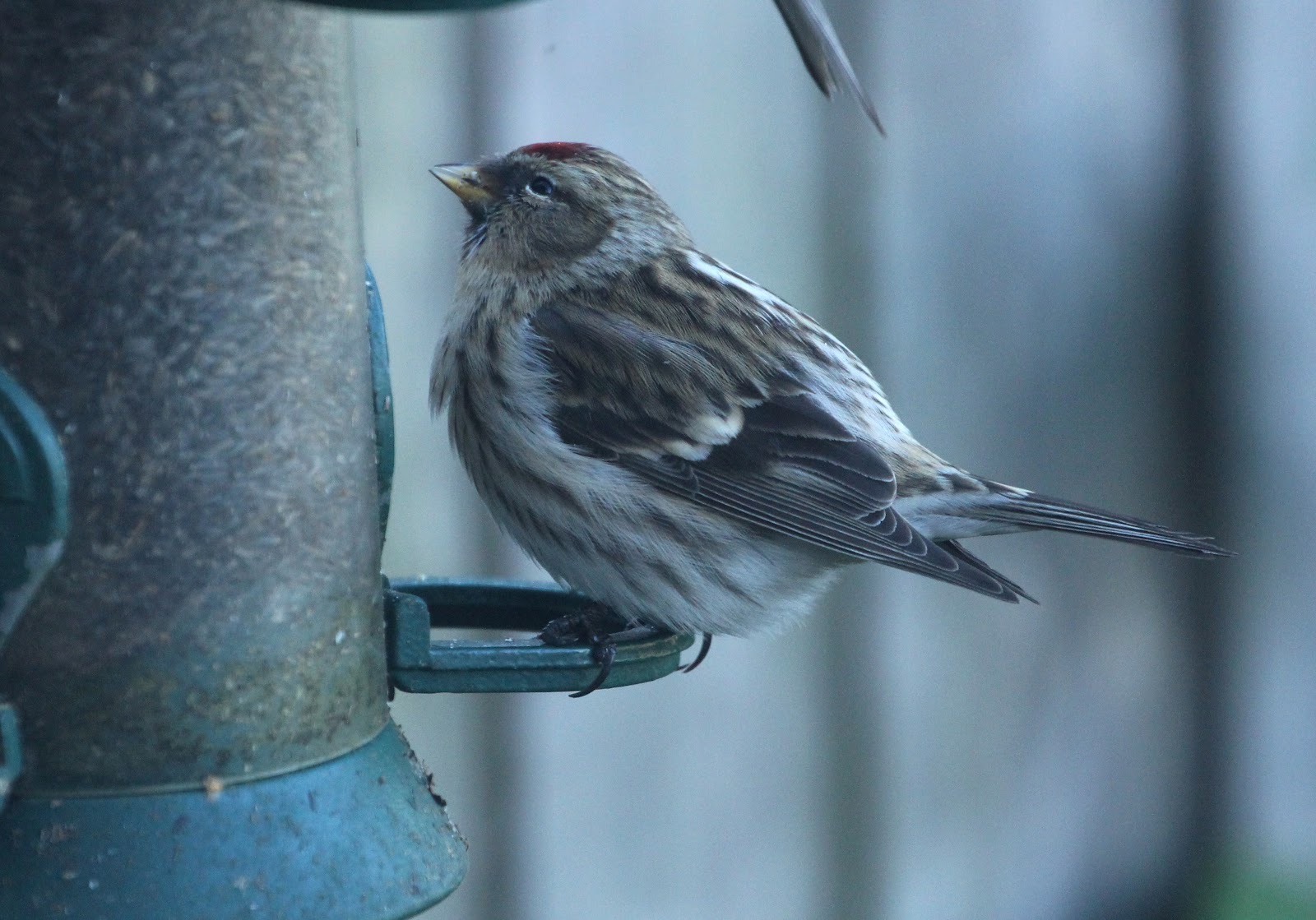
Over the past three winters, I have been nurturing an ever increasing flock of Redpolls, focused around a couple of nyger seed feeders. They twitter away all day long outside the window. At peak, 35-40 are around at once. As usual, there is an interesting array of plumage variation. Most, of course, are Lesser Redpolls, but if you take the following to be characteristics of Mealy Redpoll: grey-brown upperparts, greyer head with whitish nape collar and ‘bulging’ neck, strong white wingbars, a pale streaked rump on a white background which bleeds white into the surrounding flanks and lower back, whitish underparts and undertail coverts (some with arrow-shaped dark centres) and a long primary projection, then I have a few that fit the bill.

Unfortunately, my garden is rather dull. Redpolls are by far the commonest bird. However, if I lean out of the upstairs window on one leg and view sideways between two distant houses, I can see a sliver of the village pond. Recently, I noticed an Egyptian Goose on the pond as I drove home. A skid onto the drive and a quick run upstairs, followed by nearly one hour on one leg peering sideways and it swam across the sliver of view. Result. The problem is that the occupants of one of the above mentioned houses has an increasingly large Yucca tree growing in the crucial gap and the sliver of view is declining year on year. A midnight raid with a bowsaw has been considered, but the more obvious answer is to move. So sadly, we are leaving our glorious view over Epping Forest in the Land of Spray tan and Bling and heading to pastures new. With this momentous decision made, I got another new garden bird: a Heron came and ate all my frogs.


Thursday, 9 February 2012

Shufflers in freezing feeding frenzy

Feeding frenzy - Shufflers, Coot-muggers and a Great Crested Degree.

With a few inches of snow and an easterly breeze, I decided it was time to give Siri a go on my up-graded iPhone rather than get frozen fingers scribbling in the notebook. As I wandered around the valley, a summary of each site was carefully dictated before I headed home, hoping to find my day list magically appearing on my computer via iCloud. And there it was. Holyfield Marsh was particularly good. Apparently I saw a lot of Shufflers, 157 apparently. And also 13 Descenders, 350 Tufted Darks, 4 Snooze (3 drunks and a redhead), 15 Great Crested Degrees and a Yellow-laked Goal. I’m not sure whether I need to train Siri better or change my accent.

With large numbers of birds restricted to small areas of unfrozen water, the apparent heightened and frenzied feeding activity was interesting. Several groups of diving Coots not only had their associated kleptoparasitic Gadwalls (the ‘Coot-mugger’) but had attracted a range of other ducks and gulls. Nearby, a swirling mass of 60+ Shovelers, sorry Shufflers, continued to stir up and sift planktonic invertebrates from a small patch of water. Such feeding behaviour is typical of the Shoveler, but I can’t recall such a large group or such frenzied activity.

I had followed almost the same route around the lake back in the freezing conditions of January 1985. On that visit, the count of Smew reached a remarkable 40 birds (with at least 19 drunks), along with a Slavonian Grebe and 300 Wigeon. A Bean Goose (‘rossicus’ say my notes) had joined the adjacent Canada Goose flock but it eventually and illogically got dismissed as an escape. I think even Siri would have got that right.